

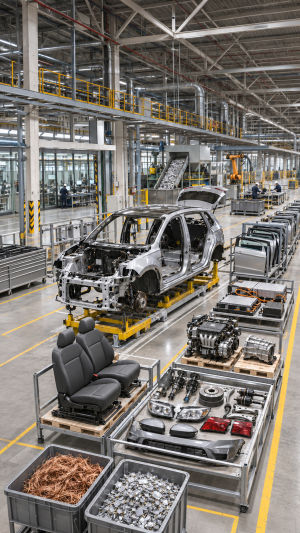
Automakers have spent decades improving how efficiently they build new vehicles. Now, several major manufacturers are looking at the other end of a car's life: what happens when it is no longer suitable for the road. Volkswagen, Toyota, Stellantis and BMW are investing in ways to dismantle vehicles, restore usable components and recover materials for future production.
The goal is not simply to reduce waste. Manufacturers also see an opportunity to create new revenue, lower material costs and make better use of existing factories. The bigger question is whether these activities can become profitable when operated on an industrial scale.
<h3>Volkswagen Builds a Dismantling Business</h3>
Volkswagen opened an industrial vehicle dismantling line at its Zwickau plant in late October 2026. The facility was initially designed to process pre-series vehicles, but the longer-term plan is to handle end-of-life cars as part of a circular manufacturing business.
Built in nine months, the line has eight dismantling stations. Volkswagen plans to process approximately 4,100 vehicles annually from 2027, using a two-shift operation. Capacity could increase to as many as 15,000 vehicles by 2030. The company intends to invest up to €90 million, with up to €10.7 million in support from the German state of Saxony. One hundred employees have already been trained for the new activities, while the operation could eventually support as many as 1,000 jobs.
<h3>Stellantis Expands Reuse and Repair</h3>
Stellantis established its Circular Economy Hub at the Mirafiori plant in Turin in 2023, with an investment of approximately €40 million. The operation covers around 73,000 square metres, including 55,000 square metres of repurposed industrial space. The group has since opened additional dismantling facilities in Brazil and Morocco.
Its business combines four activities: remanufacturing, repair, reuse and recycling. Engines, transmissions and batteries can be remanufactured; defective components can be repaired; usable parts can be sold again; and remaining materials can be recovered. The financial appeal is particularly clear in the replacement-parts market. A new engine for a 12-year-old Opel Corsa could cost around €6,000, making the repair difficult to justify.
A remanufactured engine costing less than €1,500, including a warranty, could make the vehicle worth repairing. Figures provided in connection with the project indicate that remanufactured components are often 30% to 50% cheaper than equivalent new parts. Reused original parts can cost up to 70% less.
<h3>Toyota Applies Factory Discipline</h3>
Toyota has taken a structured approach at its Burnaston plant in the United Kingdom, where its Circular Factory has operated since August 2025. The facility applies principles from the Toyota Production System to the dismantling of end-of-life vehicles. The process follows eight standardised stages with defined cycle times and takes approximately three hours per vehicle.
The site is designed to process 10,000 vehicles each year, recovering around 120,000 reusable components, 300 tonnes of high-quality plastics and 8,200 tonnes of steel and other metals. Toyota is also planning a second Circular Factory in Wałbrzych, Poland, with capacity for up to 20,000 vehicles annually.
<h3>BMW Designs for Material Recovery</h3>
BMW is addressing circular manufacturing earlier in the vehicle development process. Through its Car2Car research project, the company examined how materials from end-of-life vehicles could be recovered at a quality suitable for use in new automotive production.
Under research conditions, high-quality material recovery increased from 6% to 51%. The recovery figure for steel rose from 1% to 81%, aluminium from 23% to 52%, and copper from 48% to 68%. These results relate to the material streams examined, not the overall recycling rate of an entire vehicle.
<h3>The Financial Opportunity and Its Limits</h3>
A Boston Consulting Group study commissioned by the Federation of German Industries estimates that annual circular gross value added in Germany could rise from around €60 billion to as much as €120 billion by 2045. The study puts cumulative value-creation potential at up to €880 billion, with mobility contributing as much as €4.8 billion in additional annual value.
However, the industry faces practical obstacles. Around 25% of deregistered vehicles are currently exported outside the EU, reducing the supply of vehicles and materials available for European recycling. The study estimates that approximately €20 billion in investment will be needed across industries for circular infrastructure, including digital solutions.
Circular manufacturing offers automakers a way to recover more value from vehicles after their first use. Volkswagen is building dismantling capacity, Stellantis is expanding its parts business, Toyota is applying factory processes to vehicle recovery, and BMW is designing products with recycling in mind.
The opportunity is substantial, but profitability will depend on reliable supplies, consistent material quality, sufficient demand and investment. The real test is whether these projects can move beyond promising individual facilities and become sustainable businesses at scale.


