

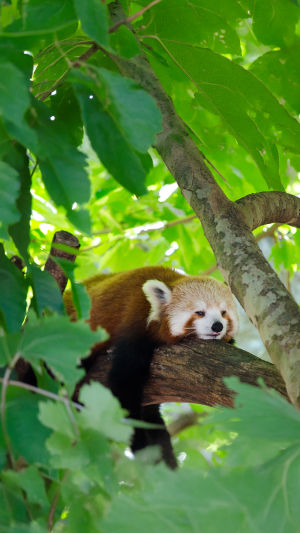
Welcome back, everyone. You have probably seen a red panda draped over a branch, looking half asleep and completely at ease.
That pose isn't laziness. It's a climbing animal resting between moves, and its body is built for exactly that kind of life.
<h3>The Extra Skeletal Structure That Grips</h3>
Red pandas have a specialized wrist projection called the <b>radial sesamoid</b> that acts much like an extra thumb. Positioned near the other digits, it lets the panda clamp its front paws around smooth bamboo stalks or slender limbs while curved, semi-retractable claws catch on bark. Thick fur across the paw soles adds extra traction on slick surfaces, and you can watch one hook tender shoots closer with steady, one-paw pulls while feeding.
<h3>A Tail That Does the Balancing</h3>
A long, ringed tail—often nearly as long as the red panda's body—serves as a living counterweight high off the ground. Shifting that bushy tail side to side helps keep balance on narrow, swaying limbs, while curling it snugly over the nose and eyes during cold snaps traps body heat. One versatile tail handles both steady footwork and cold-weather warmth.
<h3>Ankles Built for Going Down</h3>
Getting down safely matters just as much as climbing up. Red pandas can rotate their flexible ankle joints backward so their claws stay hooked into the bark while descending trunks headfirst—a trick most tree climbers cannot manage. That joint mobility gives steady control on damp, mossy trunks without forcing a slow, awkward reverse scramble.
<h3>Where the Trees Fit in</h3>
Native to mountain forests across the eastern Himalayas and southwestern China—typically between 2,200 and 4,800 meters (roughly 7,200 to 15,750 feet)—red pandas pair low-growing bamboo meals with high canopy shelter. Climbing keeps them out of reach of ground predators like snow leopards and martens while letting them soak up warm morning sun on upper limbs. Even in zoos, keepers routinely spot them perched near the highest branches.
<h3>Why Climbing Is Not Enough</h3>
Agile climbing alone cannot protect red pandas when old-growth mountain forests are cleared or broken into isolated patches. Splitting habitat leaves small groups separated and shrinks steady access to bamboo and nesting trees. Red pandas are classified as endangered, with fewer than 10,000 mature individuals estimated in the wild—making intact forest cover essential to their survival.
<h3>Protecting Their Canopy Home</h3>
Next time you watch a red panda move along a branch, notice the wrist grip, balanced tail, and nimble ankles working together aloft. Those traits reflect long adaptation to life in the trees—and show why protecting connected mountain forests is key to keeping them there.


