

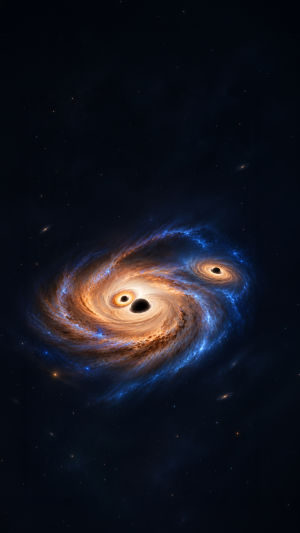
Astronomers have discovered something remarkable in a galaxy more than 12.5 billion light-years away: three actively feeding black holes inside the same system.
Because the light from this galaxy has taken billions of years to reach Earth, scientists are seeing it as it existed only about 1.2 billion years after the birth of the universe. The finding offers a rare opportunity to study how enormous black holes could grow so quickly in the young universe.
<h3>Two Black Holes Sit Very Close Together</h3>
The galaxy, known as J0148-4214, contains two active black holes near its center separated by only about 620 light-years.
A third active black hole lies much farther out, around 5,500 light-years from the center.
Lead researcher Hannah Übler explained that this is the first evidence of three active black holes inside a single galaxy at such an early stage of cosmic history.
The discovery is important because astronomers believe mergers between galaxies were common in the young universe. When galaxies collided, their central black holes could also move toward one another and eventually merge.
<h3>The Black Holes Have Very Different Masses</h3>
The three objects are far from equal in size.
The largest has an estimated mass of about 80 million times that of the Sun. The other two weigh roughly 600,000 and 2 million solar masses.
Surprisingly, the largest black hole is not the one growing most aggressively.
The smaller object, with a mass of about 600,000 Suns, appears to be consuming material at an unusually high rate, even exceeding the limit predicted by simple models of black hole growth.
This could help explain one of astronomy’s biggest puzzles: how some black holes became enormous so soon after the universe formed.
<h3>Webb Revealed What Other Telescopes Might Miss</h3>
The discovery was made using the James Webb Space Telescope.
Astronomers examined the light emitted by hydrogen gas around the galaxy. Gas near an active black hole moves at extremely high speeds, producing distinctive patterns in its spectrum.
The central region showed a particularly complex signal.
Researchers used a technique called spectro-astrometry to detect very small shifts in the position of the emissions. This allowed them to distinguish two central black holes even though the telescope could not resolve them directly as separate points.
A third active source was then identified farther out in the galaxy.
<h3>A Merger May Already Be In Progress</h3>
The two central black holes are expected to merge within the next few hundred million years.
That may sound slow, but on a cosmic scale it represents a relatively short period.
Co-author Roberto Maiolino suggested that black hole mergers may have provided an additional fast route for building the massive objects seen in the early universe.
Instead of growing only by consuming surrounding gas, black holes could also become larger by repeatedly merging with one another.
<h3>The Third Black Hole Is A Mystery</h3>
The more distant third black hole raises another question.
One possibility is that it is moving gradually toward the center of the galaxy and may eventually interact with the other two.
Another is that it formed during an earlier merger and was pushed outward by gravitational recoil. Such a kick can happen when merging black holes release gravitational waves unevenly, sending the newly formed object in the opposite direction.
At the moment, researchers cannot say which explanation is correct.
<h3>More Hidden Systems May Exist</h3>
The discovery suggests that other distant galaxies could contain multiple growing black holes that have so far gone unnoticed.
Without the detailed spatial information provided by Webb, astronomers might have interpreted the galaxy as containing only one active black hole.
Finding more systems like J0148-4214 could help scientists reconstruct how black holes assembled during the first billion years of cosmic history.
The early universe may have been far more crowded with merging black holes than previously thought — and the latest observations are beginning to reveal just how quickly those cosmic giants came together.


