

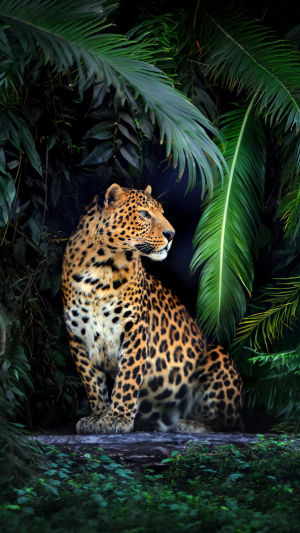
Jaguars still occupy an enormous range stretching from Mexico to northern Argentina, but the landscape connecting those populations is becoming increasingly fragmented. A new study has produced the most detailed picture yet of how the Americas’ largest cat moves through its remaining habitat.
Using real movement data rather than relying mainly on expert estimates, researchers identified the places that function as major strongholds and the corridors that allow jaguars to travel between them.
<h3>GPS Data Changed The Picture</h3>
The study used tracking information from 172 GPS-collared jaguars across much of the species’ current range.
Researchers identified 307 core areas where jaguar movement was predicted to be especially concentrated, along with 176 corridors linking those areas.
Żaneta Kaszta, one of the study’s senior authors, explained that previous attempts to map jaguar connectivity relied more heavily on expert opinion. She said the new analysis offers a more biologically realistic view because it is based on movement data collected directly from animals across multiple regions.
This distinction matters because a route that appears suitable on a map does not necessarily function as a real wildlife corridor.
<h3>South America Holds The Main Stronghold</h3>
The clearest finding was the scale of one enormous connected landscape.
A region spanning parts of the Amazon, Llanos, Pantanal and Chaco covers approximately 6.5 million sq km across 11 countries. It ranked as the most important stronghold for maintaining jaguar movement across the continent.
This vast area accounted for the overwhelming majority of predicted movement density in the model.
The Amazon remains especially important, but the strength of the wider network comes from the way several major ecosystems remain linked rather than existing as isolated pockets.
<h3>Other Populations Are More Vulnerable</h3>
Outside this large South American stronghold, the picture becomes much more fragmented.
Researchers identified major gaps in parts of Mexico, Central America, Colombia and Brazil’s Atlantic Forest. Some populations in these areas appear increasingly isolated from neighboring groups.
That isolation can become dangerous over time. Jaguars need to disperse between populations to maintain genetic diversity, establish new territories and recover from local population declines.
Senior researcher Samuel Cushman explained that jaguars remain in a stronger position than many other large carnivores because they still retain a huge connected refuge in South America. However, he warned that several regions now depend on narrow connections that could disappear if habitat conversion continues.
<h3>Protected Lands Could Fill The Gaps</h3>
The researchers also examined 905 protected areas and Indigenous lands.
This separate analysis identified 507 potential corridors that could help strengthen connectivity in the future.
The two approaches revealed slightly different things. Current jaguar movement patterns show where connections already exist, while protected areas highlight opportunities to maintain or restore links that may become increasingly important.
This is especially relevant in landscapes where agriculture, roads and urban development are narrowing the routes available to wildlife.
<h3>Corridors Still Need Field Checks</h3>
The maps do not prove that every identified corridor is currently being used.
They represent modeled pathways based on movement behavior and landscape characteristics, so field surveys are still needed to confirm how individual routes function in practice.
Researchers emphasize that these maps should therefore be treated as a guide for conservation priorities rather than a final answer.
<h3>Connectivity May Decide Their Future</h3>
Jaguars have already lost roughly half of their historic range, making the remaining links between populations increasingly valuable.
Protecting isolated reserves alone may not be enough if the landscape between them becomes impossible to cross.
The new analysis suggests that conservation efforts should focus not only on saving large areas of habitat but also on keeping narrow routes open between them.
For jaguars, survival across the Americas may ultimately depend on movement: the ability to leave one territory, cross human-dominated landscapes and reach another before those connections disappear.


