

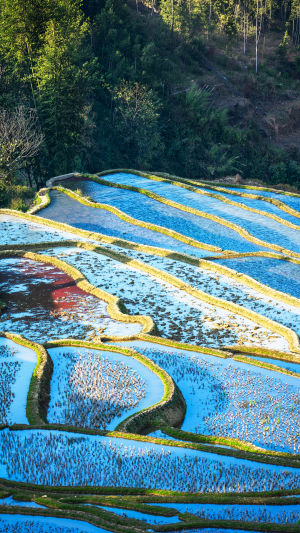
Terraced fields are a remarkable example of how people adapt to the natural landscape. Instead of leaving steep mountain slopes unused, farmers reshape them into a series of steps that provide space for growing crops.
From a distance, these fields look like giant staircases covering hillsides. However, their purpose goes beyond creating attractive scenery.
Terraces help expand farmland, reduce soil erosion, and improve water conservation. They also show how geography influences agricultural practices and how people can make better use of challenging natural environments.
<h3>What Are Terraced Fields?</h3>
Terraced fields are areas of farmland built along mountain or hillside slopes. Farmers divide the original slope into several platforms, with raised edges separating each level. These platforms follow the natural shape and elevation of the land.
Without terraces, steep slopes can be difficult to cultivate. Rainwater moves downhill quickly, carrying valuable topsoil away. By creating a series of smaller levels, terraces slow water movement and provide more manageable spaces for growing crops.
Some terraces have flat surfaces, while others retain gentle slopes. Their designs depend on the hillside's steepness, soil depth, rainfall, and farming requirements.
<h3>Why Are Terraced Fields Built?</h3>
Geography is a major reason for terrace construction. Mountainous regions often have limited flat land, making agricultural expansion difficult. Transforming suitable slopes into farmland provides additional growing space.
Growing populations and increasing food demand can also encourage terrace development. Water management is another important factor. On untreated slopes, rainwater can flow rapidly downhill. Terraces interrupt this movement, allowing more water to collect and enter the soil.
<h3>Benefits for Soil and Water</h3>
One important advantage of terraces is soil conservation. Raised edges reduce the speed of surface runoff, helping prevent valuable soil from being carried away during rainfall.
Terraces also improve water retention. Their relatively flat surfaces allow rainwater to remain in fields longer, giving it more time to soak into the ground. This can provide crops with a more reliable supply of moisture.
Another benefit is more efficient land use. Areas that might otherwise be too steep for cultivation can become productive agricultural spaces. Vegetation along terrace edges can also help stabilize the soil and support local ecological balance.
<h3>Five Common Types of Terraces</h3>
Different terrace designs respond to different geographical conditions.
<b>1. Level Terraces</b>
These terraces have relatively flat surfaces. They are commonly created by cutting into the upper slope and using the removed soil to build up the lower section. Their structure supports water retention and careful cultivation. They are suitable for crops such as rice and wheat, although construction can require considerable work.
<b>2. Alternating-Slope Terraces</b>
These designs leave sections of the original hillside between neighboring platforms. Rainwater can flow from these sloping areas toward cultivated land. Farmers may grow crops on the flat sections and maintain grass on the remaining slopes.
<b>3. Sloping Terraces</b>
These terraces retain a gentle incline rather than having completely flat surfaces. Raised boundaries slow runoff and reduce soil loss. Grass and fruit trees can also be planted along the edges to strengthen the structure.
<b>4. Reverse-Slope Terraces</b>
Their surfaces incline slightly toward the inside instead of following the natural downhill direction. This design helps retain rainwater and soil, making it useful in dry areas or locations with greater erosion risks.
<b>5. Combined Terraces</b>
These systems combine different terrace designs according to the shape of the hillside. A single area may include flat platforms, sloping sections, and vegetation strips. This flexible arrangement helps make better use of available land.
<h3>Challenges of Terrace Construction</h3>
Building terraces requires considerable labor, materials, and planning. Workers must reshape the ground, create stable edges, and sometimes install drainage systems.
Maintenance is equally important. Heavy rainfall can damage terrace boundaries, while poor drainage may cause water to accumulate in unsuitable places. Neglected structures can become unstable.
Construction may also change the original landscape. Removing too much vegetation or disturbing soil without proper planning can create environmental problems. Therefore, terrace designs should consider local drainage, soil conditions, and existing vegetation.
<h3>Final Thoughts</h3>
Terraced fields demonstrate how people can adapt agriculture to challenging landscapes. By reshaping steep slopes, they create additional farmland while helping conserve soil and water. Their different designs show that successful agricultural planning must consider local geography. With careful construction and regular maintenance, terraces can remain valuable landscapes that support farming and environmental protection.


