

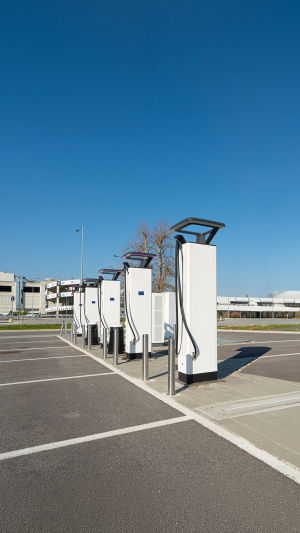
Electric vehicle drivers often face confusing prices when using public charging stations. The amount charged can depend on whether someone pays directly, uses a charging operator’s app, or accesses the station through a third-party charging service.
A recent court decision in Germany could help address this problem. The Munich I Regional Court ruled that charging operator EWE Go cannot charge roaming provider Digital Charging Solutions (DCS) higher prices than it charges its own customers without a valid reason.
<h3>A Dispute Over Charging Costs</h3>
The case involved two companies with different roles in the electric vehicle charging market. EWE Go operates public charging stations, while DCS provides charging services through digital platforms and charging cards. DCS works with vehicle brands including BMW and Mercedes-Benz, helping drivers access charging networks through a single service.
To offer charging at stations operated by other companies, service providers such as DCS pay fees to the station operators. Those costs influence the prices eventually presented to drivers. When the wholesale price is too high, a roaming provider may struggle to offer competitive charging rates.
DCS argued that EWE Go was applying unfair price differences. The company brought the case before the Munich I Regional Court, relying on rules designed to prevent discrimination in the public charging market.
<h3>Why the Price Difference Matters</h3>
The disagreement centred on prices charged at the same EWE Go charging locations. On the reference date of January 1, 2025, EWE Go required roaming providers such as DCS to pay €0.837 per kilowatt-hour under its Offer2All arrangement.
However, drivers paying directly at the station faced a lower rate of €0.79 per kilowatt-hour. Customers registered through EWE Go’s own app paid just €0.52 per kilowatt-hour for the same electricity. The difference was substantial. The rate charged to roaming providers was approximately 60% higher than the price offered to EWE Go’s registered customers.
DCS also challenged a separate blocking fee of €0.10 per minute, excluding tax. This charge applied to mobility service providers but was not imposed on direct customers or users of the EWE Go app at the relevant time. For charging services, such differences can make it difficult to offer consistent prices across several networks.
<h3>What the Court Decided</h3>
On October 6, 2026, the Munich I Regional Court ruled in favour of DCS. It found that EWE Go could not continue charging the roaming provider higher prices than its own customers under the circumstances challenged in the case. The decision also addressed the additional blocking fee. The court's ruling means EWE Go cannot apply the disputed price differences and separate fee without an acceptable justification.
A central part of the case involved Article 5(3) of the European Union’s Alternative Fuels Infrastructure Regulation, commonly known as AFIR. This rule requires operators of publicly accessible charging points to avoid discriminatory pricing between drivers and mobility service providers, as well as between different service providers. Different price levels may be permitted, but they must be proportionate and objectively justified.
<h3>Could Drivers Pay Less?</h3>
The ruling could create opportunities for roaming providers to offer more competitive prices. When a charging service pays a lower wholesale rate, it may have greater flexibility to set attractive tariffs for its customers. DCS believes the decision could bring roaming prices closer to the rates offered directly by charging station operators. However, this does not mean every driver using a third-party app will automatically pay the same price as a registered customer of the station operator.
<h3>The Decision Is Not Yet Final</h3>
Although the judgment is important, it is not legally final. EWE Go said it would review the court's reasoning before deciding how to proceed. The company did not provide further details while the legal proceedings remained ongoing. The court also found EWE Go liable for damages suffered by DCS from April 13, 2024, when the relevant AFIR provisions came into force.
Much will depend on whether the decision becomes final and how the industry responds. Still, the case represents a meaningful step towards clearer pricing practices, giving drivers reason to hope that using different charging apps and cards will become less confusing in the future.


