

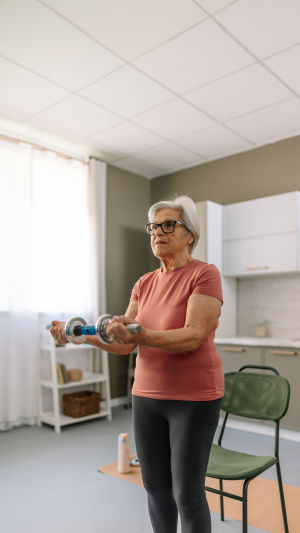
Maintaining physical strength does not always require lengthy gym sessions or complicated workout schedules.
Research from Penn State suggests that a carefully designed routine lasting just four minutes each day may improve important aspects of physical performance among people aged 65 and older.
<h3>Why Everyday Strength Matters With Age</h3>
Physical ability influences many ordinary activities, including climbing stairs, rising from a chair, carrying groceries, and walking across uneven surfaces. As strength and balance decline, these movements can become more challenging, potentially limiting independence.
Resistance training helps address this problem by requiring muscles to work against an opposing force. That force can come from body weight, resistance bands, or other equipment. Regular practice can improve strength and coordination, helping people perform movements that are essential for daily life.
Despite these potential benefits, maintaining an exercise routine can be difficult. Long workouts may feel intimidating, while discomfort, limited time, and uncertainty about which exercises to perform can discourage participation. The Penn State research team investigated whether reducing the time commitment could make strength training more manageable without eliminating its practical benefits.
<h3>Inside the Four-Minute FAST-2 Program</h3>
The study involved 97 participants with an average age of 74. Researchers randomly assigned participants either to the exercise program or to a comparison group that received no intervention. The exercise group followed a routine called Functional Activity Strength Training-2, or FAST-2.
The program included four movements designed to strengthen different muscle groups and support practical mobility:
<b>Push-ups:</b> Build upper-body strength, with wall or countertop variations available for easier practice.
<b>Chair stands:</b> Train the legs through repeated transitions from sitting to standing.
<b>Two-arm rows:</b> Use resistance bands to strengthen the upper body.
<b>Stair stepping:</b> Challenge the legs and practice movements relevant to climbing steps.
Each exercise lasted 30 seconds, followed by 30 seconds of rest. Together, the four exercises and recovery periods created a four-minute session.
Participants received resistance bands, an adjustable stepper, and written instructions. The program also allowed easier variations and encouraged gradual increases in difficulty as physical ability improved. This flexible approach matters because an effective exercise plan should match individual capabilities. Anyone with balance difficulties, persistent pain, or an existing medical concern should seek appropriate professional guidance before starting a new routine.
<h3>Measurable Improvements After 12 Weeks</h3>
The researchers assessed participants using tests that measured chair-standing ability and balance while standing on one leg. These activities provide useful information because they reflect physical skills needed throughout everyday life. After 12 weeks, the exercise group showed several improvements compared with baseline measurements.
Participants completed an average of 4.2 additional chair stands during a 30-second test and improved one-leg balance time by 3.6 seconds. Performance on a sit-to-stand assessment also improved, with completion time decreasing by 2.3 seconds.
<h3>Consistency May Be the Most Important Advantage</h3>
An especially encouraging finding concerned participation. Participants completed the routine on 81% of study days, suggesting that the short sessions were practical for many people involved in the trial. Consistency is essential to building strength. A theoretically excellent program provides limited benefit if the time commitment makes regular participation unlikely. Short sessions may reduce that barrier by making exercise easier to fit around household responsibilities and other daily activities.
However, four minutes should not automatically be considered a complete replacement for broader physical activity. Walking, aerobic exercise, flexibility work, and additional strength training can contribute different benefits. The appropriate combination depends on individual needs and abilities.
<h3>Expert Insight</h3>
Christopher Sciamanna, a professor of medicine and public health at Penn State College of Medicine and lead author of the research, highlighted the body's capacity to respond to regular activity. In the university's research report published by ScienceDaily, Sciamanna stated: “The human body is designed to improve very quickly.”
Further research is needed to determine whether these improvements translate into fewer falls, sustained independence, or lasting benefits beyond the study period. For now, the findings support a realistic principle: regular, appropriately adapted movement can be a useful starting point for preserving physical capability as the years progress.


