

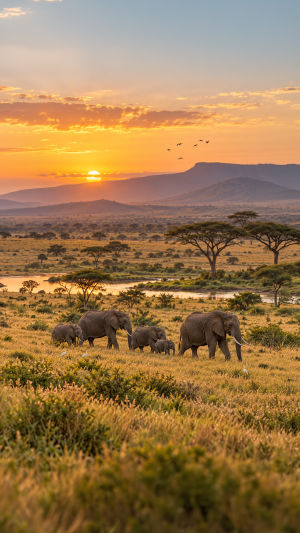
Elephants are among Africa's most influential animals, shaping entire ecosystems through their feeding habits, movement and interactions with vegetation. However, new research suggests their environmental influence continues long after their lives end.
An international team studying elephant remains in South Africa's Kruger National Park discovered that decomposition creates nutrient-rich areas that can persist for at least eight years.
The findings, published in Proceedings of the National Academy of Sciences, reveal an unexpected relationship between soil fertility, biodiversity and wildlife behaviour.
<h3>How Elephant Remains Transform The Soil</h3>
The research began after a large bull elephant named Alexander died naturally in Kruger National Park in 2009. Scientists became interested in how an animal weighing several tonnes could influence the surrounding environment during decomposition. Their investigations revealed dramatic changes in soil chemistry.
At recently formed carcass sites, nitrogen concentrations were sometimes up to 3,000 times higher than in surrounding areas. However, this sudden abundance of nutrients initially prevented vegetation from recovering.
High concentrations of ammonium created toxic conditions for plants, leaving patches of exposed soil where the elephant had died.
<h3>Why More Nutrients Mean Less Biodiversity</h3>
As decomposition progressed, nutrients gradually became available to microorganisms and plants.
Microbial activity increased considerably, but the number of different microbial species declined.
Researchers believe that a small group of fast-growing organisms gained an advantage in the unusually nutrient-rich conditions.
Vegetation eventually returned, although the recovering plant community was dominated by relatively few species.
This surprising pattern demonstrates that greater nutrient availability does not necessarily support higher biodiversity.
The effects remained detectable even at sites where elephants had died eight years earlier.
<h3>Why Other Animals Keep Returning</h3>
Although plant diversity declined, the vegetation growing around former carcass sites became particularly nutritious.
Researchers discovered elevated nitrogen concentrations in grasses, making them attractive to grazing animals. Herbivores repeatedly visited these areas, even years after the elephant's remains had disappeared. Their activity created an additional ecological effect.
As grazing animals returned, their manure contributed further nutrients to the soil, potentially helping maintain the unusually fertile conditions. This cycle demonstrates how the death of one large animal can influence the behaviour of many others across an ecosystem.
<h3>Could Other Ecosystems Show Similar Effects?</h3>
Scientists compared these findings with the ecological changes caused by whale carcasses on the ocean floor. However, the consequences differ because African savannas already contain relatively abundant nutrients.
Researchers suspect that savannas may provide particularly suitable conditions for long-lasting changes following the decomposition of large animals.
In wetter environments, rainfall could wash nutrients away more quickly. Deserts, meanwhile, may lack sufficient moisture for microorganisms and vegetation to respond strongly. Further studies are needed to establish whether similar patterns occur elsewhere.
<h3>What The Discovery Means For Conservation</h3>
The research highlights an overlooked ecological contribution of large animals.
Elephants influence their surroundings throughout their lives, but their remains can also create lasting changes in soil chemistry, vegetation and grazing patterns. Scientists now plan to examine how rainfall, drought and other environmental conditions affect these processes. The findings could improve understanding of ecosystems where large herbivores have disappeared.
Preserving elephants may therefore protect ecological relationships that extend far beyond the animals themselves, including processes that continue after their death.


