

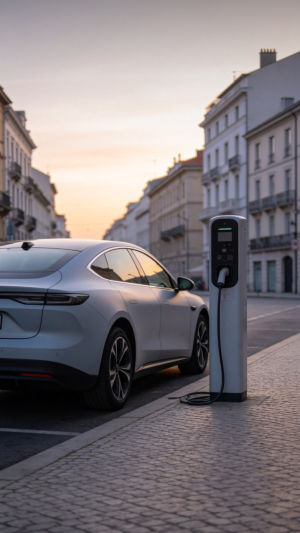
Europe’s transition to electric mobility gathered more pace in July, with battery-electric vehicles taking a larger share of new registrations and charging infrastructure continuing to grow.
Preliminary EU27 data show that 202,597 battery-electric cars were registered during the month. Across the 12 EU countries already reporting July figures, BEV registrations were 41.8% higher than a year earlier.
At the same time, publicly accessible charging infrastructure across the EU reached 1,157,551 points, up 15.2% year on year.
<b>The latest figures suggest that electric mobility is expanding on two fronts at once: more drivers are choosing BEVs, while the infrastructure needed to support them is also becoming more extensive.</b>
<h3>BEVs Take a Bigger Share</h3>
Battery-electric cars accounted for 26.3% of new passenger-car registrations in July.
That means more than one in four new cars registered was fully electric. The result reinforces a broader trend already visible across Europe in 2026, where BEVs are gradually moving from a fast-growing niche into a major part of the mainstream new-car market.
Growth is not evenly distributed, however. Some countries are expanding rapidly, while others are moving at a slower pace depending on incentives, charging availability, taxation and consumer confidence.
<h3>France Leads the Growth</h3>
Among the 12 EU countries with July data available, France recorded the strongest year-on-year increase. BEV registrations there jumped 127.1%. Ireland followed with growth of 96.2%.
Germany, Luxembourg and Finland also posted gains of more than 50%. Germany remained the largest market in absolute terms, recording 78,609 battery-electric registrations during the month. France followed with 44,378. Even the slowest-growing country in the group still posted a positive result. Belgium recorded year-on-year growth of 23.3%.
<b>Every one of the 12 reporting markets recorded an increase, showing that EV growth is broadening rather than depending on only one or two countries.</b>
<h3>Germany Still Matters Most</h3>
Germany’s position is especially important because of the size of its car market. Strong BEV growth there has a large effect on the overall European total.
A market of that scale shifting toward electric cars also influences manufacturers, charging providers and infrastructure investment. France is increasingly important for the same reason. The combination of strong growth in two of Europe’s biggest automotive markets gives the wider transition much more weight than expansion in smaller countries alone.
<h3>Charging Keeps Expanding</h3>
Public charging infrastructure also continued to grow in July. The EU now has more than 1.15 million publicly accessible charging points.
That represents a 15.2% increase compared with July 2025. This matters because electric-car adoption depends not only on vehicle availability, but also on whether drivers feel confident about where they can recharge.
More charging points can reduce range anxiety, improve long-distance usability and make EV ownership more practical for people who cannot charge at home.
<b>Vehicle growth without charging growth would eventually create bottlenecks, so the continued expansion of both is an important sign of a healthier market.</b>
<h3>Data Coverage Is Still Uneven</h3>
The July figures are preliminary and not every EU country has reported data for the same period.
Belgium, the Czech Republic, Denmark, Finland, France, Germany, Ireland, Italy, Luxembourg, the Netherlands, Spain and Sweden are updated through July.
Other EU Member States are currently updated through June.
That means the picture is useful for identifying the direction of travel, but the full EU comparison will become clearer once all countries report for the same period. The next major data update is scheduled for mid-September.
<h3>A Transition Still in Motion</h3>
The latest numbers show a European EV market that is continuing to strengthen rather than plateau. Registrations are rising quickly, BEVs now account for more than a quarter of new passenger cars, and public charging infrastructure is expanding at a double-digit rate. There are still large differences between countries, and not all markets are moving at the same speed. But the overall direction remains clear.
<b>July’s data show that electric mobility in Europe is becoming more established both in vehicle sales and in the infrastructure behind them. The strongest signal is not any single record, but the fact that growth is appearing across multiple major markets at the same time.</b>


