

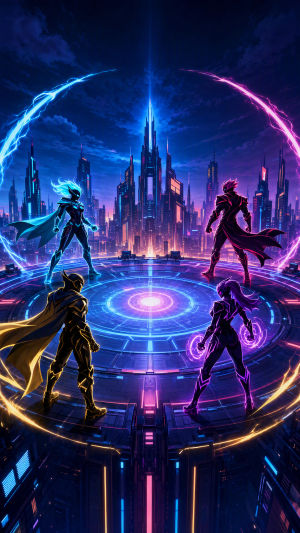
Marvel Tōkon: Fighting Souls could have relied on famous superheroes and spectacular attacks. Instead, Arc System Works has built a technical team fighter with a strong identity of its own.
The game centres on <b>4v4 battles</b>, shared health and carefully timed assists. It feels less like a conventional licensed release and more like Marvel filtered through the style of Guilty Gear.
<h3>A Different Team System</h3>
You control one fighter directly while teammates provide assists. As the match develops, the rest of the team becomes increasingly important.
Unlike many tag fighters, everyone shares one health bar. Switching characters does not restore health, so success depends more on timing, positioning and choosing the right teammate for each situation.
Different fighters specialise in different roles, from ranged pressure to aggressive close combat. Building a strong team therefore means thinking about how four characters work together rather than simply picking favourites.
<h3>Every Fighter Has Personality</h3>
The roster avoids feeling repetitive.
Spider-Man is fast and mobile, Captain America is more direct, while Ghost Rider introduces mechanics linked to overheating. Peni Parker relies heavily on her mech, and Carnage brings a more unusual combat style.
Each character has individual systems, strengths and weaknesses. Learning someone new therefore feels genuinely different rather than simply memorising another version of the same moves.
<h3>Easy Inputs, Hard Strategy</h3>
Simplified special moves and easier combo options make the first hours surprisingly approachable.
You can perform impressive attacks without immediately learning complicated directional inputs.
But beneath that accessibility is a demanding fighting system.
Players need to understand assists, positioning, defensive choices and the Assemble meter, which powers stronger team actions.
Knowing one fighter well is not enough. You need at least a basic understanding of the entire team.
<b>The controls are accessible, but mastering the strategy takes considerably more effort.</b>
<h3>A Steep Learning Curve</h3>
The biggest challenge is the amount of information on screen.
Once multiple characters and effects appear simultaneously, fights can become chaotic. Experienced players may enjoy that complexity, while newcomers could initially feel overwhelmed.
Fortunately, the training tools are strong.
The best approach is to learn gradually: focus first on movement, simple combos and one or two reliable assists. More complicated team sequences and resource management can come later.
<h3>Story Mode Is Actually Useful</h3>
The single-player content is better than expected.
Several teams receive their own stories involving both heroes and villains. The plot is fairly straightforward superhero material, but the character interactions are entertaining.
More importantly, story battles provide an enjoyable way to test unfamiliar fighters.
Instead of learning everything through command lists, players can experiment with different teams while progressing through structured matches.
That makes the mode useful as well as entertaining.
<h3>Marvel Gets an Anime Makeover</h3>
Visually, Tōkon is one of the game’s biggest successes.
Arc System Works is known for making 3D models resemble hand-drawn animation, and that technique works extremely well with Marvel.
Characters have exaggerated poses, dramatic silhouettes and explosive attacks. Familiar heroes do not simply copy their film versions; they have been redesigned through a distinctive anime-inspired style.
The stages are equally energetic, turning recognisable Marvel locations into colourful arenas rather than passive backgrounds.
<h3>Controlled Chaos</h3>
With four fighters per team, the action can become visually intense.
Assists and large attacks frequently overlap, filling much of the screen.
Yet the game remains surprisingly readable once you understand its visual language. Strong animation helps communicate where attacks are coming from and why a particular move connected.
That balance between spectacle and clarity is essential in a competitive fighter, and Tōkon handles it well.
<h3>Online Play Adds Depth</h3>
The team system creates a huge number of possible combinations.
A character who seems average alone may become extremely useful when paired with the right assist. This makes multiplayer especially rewarding for players who enjoy experimentation.
Finding unexpected combinations, refining strategies and learning matchups gives the game strong long-term potential.
<h3>Complexity Cuts Both Ways</h3>
Tōkon’s greatest strength is also its main weakness.
Managing four characters is significantly harder than controlling one. Simplified inputs reduce mechanical difficulty, but they cannot remove the complexity of team strategy.
New players may occasionally feel as though they are playing a strategy game and a fighter at the same time.
Yet removing that complexity would also remove much of what makes the game distinctive.
<h3>One of 2026’s Standouts</h3>
Marvel Tōkon succeeds because it does not expect the licence to carry the experience.
Its characters are recognisable, but the combat system, team structure and visual design give the game a personality of its own.
The 4v4 battles feel fresh, the roster is varied and the anime-inspired presentation gives every fight enormous energy.
<b>It can be demanding and occasionally overwhelming, but that depth is exactly what keeps Marvel Tōkon interesting after the initial superhero spectacle wears off.</b>
For players willing to learn its systems, it stands among the strongest fighting games of 2026.


