

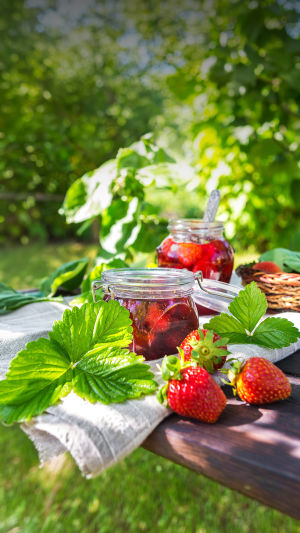
Hey Lykkers! Fresh strawberries, a little sugar, and lemon juice are all it takes to make a bright, fruity strawberry jam at home. This simple recipe transforms ripe berries into a thick, glossy spread with plenty of natural strawberry flavor.
The recipe uses only three main ingredients, making it especially useful when strawberries are plentiful. Very ripe berries work beautifully because their flavor becomes more concentrated as they cook. Instead of letting soft strawberries go to waste, turn them into a homemade preserve that can be enjoyed for days.
<h3>Ingredients</h3>
- 2 pounds (900 g) fresh strawberries, washed, hulled, and halved
- 1¼ cups (250 g) granulated sugar
- 2 tablespoons (30 mL) fresh lemon juice
For the best flavor, choose strawberries that are deeply red, fragrant, and fully ripe. Slightly soft berries are excellent for jam as long as they are fresh and completely free from mold. Any berries showing mold should be discarded rather than trimmed and used.
<h3>Equipment</h3>
A few basic kitchen tools are helpful:
- Medium or large bowl
- Candy thermometer
- Wooden or non-metal long-handled spoon
- Mason jars or other suitable jam jars
- Small plate for the chilled-plate test
<h3>How to Make Strawberry Jam</h3>
<b>1. Prepare the Strawberries</b>
- Wash the strawberries thoroughly and remove the green tops. Cut each berry in half and roughly chop larger pieces.
- The size of the fruit at this stage affects the finished texture. Larger pieces will remain more noticeable, while smaller pieces break down more quickly during cooking. For a rustic jam, rough chopping is enough.
<b>2. Combine the Ingredients</b>
- Place the prepared strawberries in a large bowl. Add 1¼ cups (250 g) of granulated sugar and 2 tablespoons (30 mL) of lemon juice.
- Stir everything together so the sugar begins coating the berries. Set the bowl over medium-high heat.
<b>3. Bring the Mixture to a Boil</b>
- Stir frequently as the strawberries begin releasing their juices. The mixture will become increasingly liquid as it heats.
- Once it reaches a boil, reduce the heat to medium-low. Maintain a steady simmer rather than a vigorous boil. Strawberry jam can bubble aggressively, and cooking it too hard may cause the mixture to overflow.
- Continue stirring regularly, especially as the liquid starts evaporating.
<b>4. Simmer Until Thick</b>
- Allow the strawberries to simmer for approximately 45 minutes, stirring frequently.
- As the water evaporates, the mixture will gradually become thicker and more syrupy. The strawberries will soften and break apart naturally.
- For a smoother texture, gently mash larger pieces with a potato masher during cooking. Those who prefer an especially smooth jam can process the raw strawberries briefly in a food processor before adding them to the bowl.
- Using a candy thermometer, continue cooking until the mixture reaches approximately 220°F (104°C).
<b>5. Check the Consistency</b>
- Temperature is useful, but the final texture is the most important indicator.
- For a chilled-plate test, place a small plate in the freezer before cooking the jam. When the mixture appears thick, put a tiny spoonful onto the cold plate and return it to the freezer for a few minutes.
- Remove the plate and gently push or tilt the jam. If it has thickened to the desired consistency, remove the bowl from the heat. If it still looks very runny, continue simmering and test again.
- Remember that the jam will become firmer as it cools.
<b>6. Transfer to Jars</b>
- Carefully ladle the hot jam into clean, sterilized Mason jars. Leave appropriate headspace if the jars will be processed for longer-term storage.
- Allow the filled jars to cool before refrigerating. For this recipe, chilling the jam overnight gives it time to develop a thicker, spreadable texture.
<h3>Helpful Tips for Better Jam</h3>
- Stir often. Frequent stirring helps prevent the fruit and sugar from sticking to the bottom of the bowl and burning. Use a long-handled spoon and take care because hot jam can splatter.
- Choose flavorful strawberries. Since strawberries provide most of the flavor, fragrant, deeply colored fruit will produce a much better jam than bland berries.
- Do not use moldy fruit. Overripe and soft strawberries are perfectly suitable, but fruit showing mold should be discarded.
- Sterilize the jars. Clean jars can be sterilized using an appropriate dishwasher sterilization cycle or by placing heat-safe jars and lids in boiling water for about 15 minutes. Always follow safe canning practices if preparing jam for long-term shelf storage.
- Let the jam cool completely. Freshly cooked jam may appear thinner than expected. Cooling allows it to firm up into the familiar spoonable consistency.
Homemade strawberry jam is simple enough for everyday cooking yet special enough to make when fresh berries are at their peak. With only three ingredients and a little patience at the stove, ripe strawberries can become a bright, versatile preserve with a wonderfully fresh flavor.


