

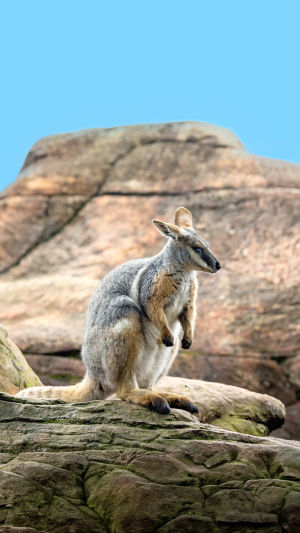
When we watch kangaroos moving across wide landscapes, we often focus on their powerful legs and impressive jumps. However, there is another amazing feature that deserves our attention: the kangaroo’s tail.
This strong and flexible tail is not just used for balance. It also works as a support tool, energy helper, and even a “fifth leg” during certain movements.
Today, we will discover how this special body feature helps kangaroos move, survive, and adapt to their environment.
<h3>A Strong Tail With A Special Design</h3>
A kangaroo’s tail is very different from the tails of many other animals. It is made of many connected sections of vertebrae, supported by strong muscles, nerves, and blood vessels. These parts work together to create a structure that is both powerful and flexible.
The muscles inside the tail allow a kangaroo to control its movement with great accuracy. It can lift, lower, bend, and adjust the tail depending on what the body needs. When a kangaroo stands still, the tail works like a strong support column, helping the animal keep a steady position.
The size and strength of the tail are also important. A kangaroo’s body depends on this extra support when resting, moving slowly, or preparing for a jump. Without this powerful tail, many of its natural movements would become much harder.
<h3>The Hidden Energy System</h3>
One of the most fascinating abilities of the kangaroo’s tail is its role in managing energy. When a kangaroo jumps, its body creates a large amount of movement force. The tail helps control this force by bending and adjusting during each movement.
When landing, the tail can help absorb part of the movement. When preparing for another jump, it assists the body in creating a smoother motion. This action is similar to a flexible spring that stores and releases energy. Because of this special design, kangaroos can travel across large areas more efficiently. In places where animals may need to search for food and water over long distances, saving energy becomes a valuable advantage.
<h3>The Amazing Fifth Leg Function</h3>
Most people recognize kangaroos as excellent jumpers, but their slow walking style is equally interesting. When moving quickly, kangaroos mainly use their powerful back legs. However, when moving slowly, they use a special five-support walking method.
During this movement, the front legs and tail help support the body while the back legs move forward. Then the tail helps stabilize the body as the front part moves again. Through this process, the tail acts almost like an additional leg.
This unique method provides several benefits. It helps reduce pressure on the back legs during slow movement. It also improves stability because the kangaroo can keep multiple points of support on the ground. In addition, the tail helps the animal adjust its direction and movement when traveling across uneven surfaces.
<h3>Built For Challenging Landscapes</h3>
Kangaroos live in environments where movement skills are extremely important. Open fields, dry areas, and changing ground conditions require animals to stay balanced and flexible.
The strong tail gives kangaroos better control when they need to slow down, turn, or change their body position. It works together with the legs to create smooth and coordinated movement.
Young kangaroos gradually learn how to use their tails as they grow. Through practice, they improve their coordination and become better at jumping, walking, and maintaining balance.
<h3>A Long Journey Of Evolution</h3>
The kangaroo’s powerful tail developed through a long process of natural change. Early ancestors of kangaroos were much smaller animals with ordinary tails that mainly helped with balance.
As generations passed, animals living in Australia faced different environmental conditions. Changes in temperature, available resources, and landscapes encouraged the development of useful features.
Over time, the kangaroo tail became longer, stronger, and more flexible. It changed from a simple balancing tool into a multifunctional body part that supports movement, stability, and survival.
<h3>A Tail Full Of Natural Intelligence</h3>
The kangaroo’s tail is also part of its body language. Along with posture and movement, the position of the tail can provide signals about the animal’s condition and actions.
When we study kangaroos, we see that every part of their body has a purpose. Their powerful legs help them travel, while their remarkable tail provides balance, support, and control.
Lykkers, the next time we see a kangaroo jumping across the landscape, let’s remember that its success comes from more than just strong legs. Behind every impressive movement is a carefully designed tail that plays a quiet but essential role. What other animals do you think have surprising body features that help them survive? Let’s continue exploring the amazing ideas found in nature together.


