

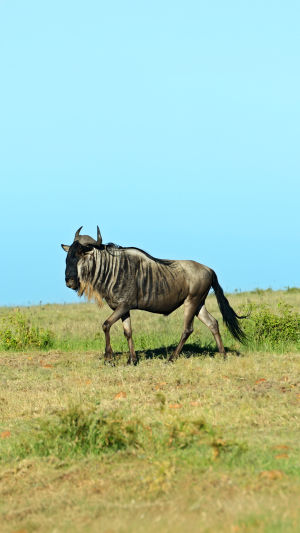
Hello, Lykkers! Have you ever spotted an animal that looks as if it combines the features of several different creatures? The blue wildebeest is one of the most recognizable animals on the African grasslands.
With a horse-like body, a broad bull-like head, a beard-like tuft under its chin, and dark stripes across its shoulders, it has an appearance that is both unusual and unforgettable.
Every feature plays an important role in helping it adapt to life on the open plains. Let's discover why this remarkable grazer has become one of Africa's best-known wildlife icons.
<h3>A Body Designed for the Plains</h3>
The blue wildebeest has a sturdy build that allows it to travel great distances. A full-grown individual usually weighs about 290 kilograms and stands on strong legs built for endurance. Even though it looks heavy, it can run surprisingly fast when moving with the herd.
Its most distinctive feature is the series of dark stripes across its shoulders and upper body. A long black mane flows from the neck to the chest, adding to its striking appearance. Many people describe the animal as looking like several species combined because of its unique mix of features. This unusual appearance makes it one of the easiest grassland animals to recognize from far away.
<h3>Living Together in Large Herds</h3>
Blue wildebeest spend nearly their entire lives in groups. They prefer wide grasslands close to reliable water sources where fresh grass grows throughout the year. Living together provides many advantages. With hundreds or even thousands of companions nearby, more eyes and ears are available to notice changes in the surroundings.
Family growth is relatively slow because a female usually gives birth to only one calf at a time. Young calves quickly learn to walk and stay close to their mothers, joining the herd on its long journeys only a short time after birth.
<h3>The Great Seasonal Migration</h3>
One of the most famous wildlife events on Earth is the annual migration of blue wildebeest. As rainfall changes across the grasslands, fresh grazing areas appear in different places. To find the best food and water, enormous herds begin traveling together across vast landscapes.
The sight is truly impressive. Thousands of animals move in the same direction, creating what looks like a dark river flowing across the plains. During the journey, they cross rivers, open fields, and uneven ground while remaining close to one another.
This movement also benefits the grassland itself. As the herds graze in different regions throughout the year, plants have time to recover naturally, helping maintain a healthy balance across the ecosystem.
<h3>The Blue Wildebeest’s Role in the Grassland Ecosystem</h3>
The blue wildebeest plays an important part in the grassland ecosystem. Its grazing encourages new plant growth, while its seasonal movements help support the many species that share its habitat.
Wildebeests also form part of the natural food web, contributing to the balance between wildlife populations. By travelling together across vast grasslands, they help connect different parts of this rich and interdependent ecosystem.
<h3>Excellent Teamwork and Communication</h3>
Life in a herd depends on cooperation. Experienced individuals often move near the front, helping guide the group toward fresh grazing areas and water. Younger members remain protected in the middle, while stronger animals stay alert around the edges.
Blue wildebeest communicate through a variety of sounds and also leave scent marks using special glands near their feet. These natural markers help herd members follow familiar paths during migration. They also have an excellent sense of smell, allowing them to detect fresh grass, water, and changes in their surroundings from several kilometers away.
<h3>A True Symbol of the African Grasslands</h3>
The blue wildebeest is much more than an unusual-looking animal. Its remarkable appearance, powerful migration, and strong social behavior make it one of the defining symbols of the African grasslands. By traveling together and adapting to changing seasons, these animals continue a natural cycle that has shaped the landscape for countless generations.
Dear Lykkers, if you had the chance to watch thousands of blue wildebeest moving across the endless plains, would it be on your travel wish list? Share your thoughts with us, and let's continue exploring the amazing stories hidden within the natural world together!
Wildebeest Migration | National Geographic
Video by National Geographic


