

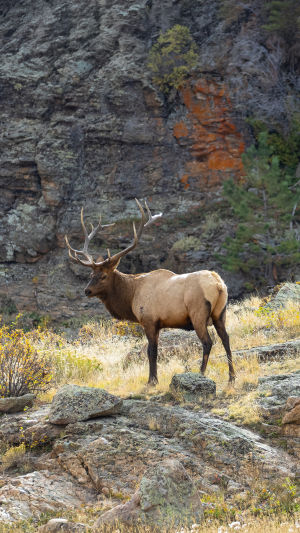
Welcome, Lykkers! When people think of giant deer, elk almost always come to mind. Towering over forests and mountain valleys, these impressive animals combine remarkable height, powerful muscles, and enormous antlers into one of nature's most striking packages.
Despite sharing the deer family with much smaller relatives such as roe deer or white-tailed deer, elk have evolved to thrive in demanding environments where size offers clear survival advantages.
<h3>A Giant Built by Evolution</h3>
Elk (Cervus canadensis) belong to one of the largest deer species on Earth. Bulls commonly weigh between 320 and 500 kilograms (700–1,100 pounds), although exceptionally large individuals may exceed these figures in productive habitats. Cows are noticeably smaller but still outweigh many other deer species.
Their ancestors evolved across Eurasia before populations spread into North America via the Bering Land Bridge during the Ice Ages. Over thousands of generations, natural selection favored larger individuals capable of surviving cold winters, traveling long distances, and competing successfully during the breeding season.
Unlike smaller woodland deer that rely mainly on hiding from predators, elk often inhabit open forests, meadows, and mountain valleys. In these landscapes, greater body size improves endurance, increases energy reserves, and helps adults defend themselves against wolves, bears, and other predators.
<h3>Long Legs and Powerful Frames</h3>
One reason elk appear even larger than their weight suggests is their exceptional height. Mature bulls can stand around 1.5 meters (5 feet) at the shoulder, supported by long, muscular legs designed for efficient movement across rugged terrain. These legs are essential for migrating between seasonal habitats.
Some elk populations travel dozens or even hundreds of kilometers each year, climbing steep mountain slopes in summer before descending into lower valleys when winter arrives. Their sturdy broad hooves, and strong tendons allow them to cross rivers, snowfields, and rocky landscapes with surprising agility. Their deep chest houses large lungs and a powerful heart, enabling sustained movement over long distances without quickly exhausting their energy reserves.
<h3>A Diet That Supports Massive Growth</h3>
Large bodies require enormous amounts of food. Elk are herbivores with highly adaptable feeding habits, allowing them to take advantage of changing vegetation throughout the year. During spring and summer, they consume nutrient-rich grasses, flowering plants, sedges, and fresh leaves. These foods contain abundant protein, minerals, and digestible carbohydrates that fuel muscle development and support rapid body growth.
As autumn approaches, elk shift toward shrubs, twigs, bark, and evergreen vegetation when fresh forage becomes less available. Their four-chambered stomach allows them to ferment tough plant material through microbial digestion, extracting nutrients that many animals cannot access. This flexible diet enables elk to maintain large body sizes across forests, grasslands, mountains, and northern regions where food quality changes dramatically with the seasons.
<h3>Why Bulls Grow Enormous Antlers</h3>
One of the defining features of male elk is their spectacular antlers, which rank among the largest produced by any living deer. Each spring, increasing daylight stimulates hormones that trigger antler growth. Covered in soft, blood-rich velvet, the antlers expand at astonishing speed. At peak growth, they may increase by more than 2 centimeters (nearly 1 inch) each day, making antlers one of the fastest-growing tissues found in mammals.
During the autumn breeding season, bulls use their antlers to display strength, spar with rivals, and establish dominance. Larger antlers often signal excellent health and nutritional condition, making bulls more attractive to females. Growing these structures demands extraordinary amounts of calcium, phosphorus, protein, and energy, explaining why only healthy, mature bulls develop the largest racks.
<h3>Surviving Harsh Climates</h3>
Large size also helps elk survive cold environments through a biological principle known as Bergmann's rule. Animals living in colder regions often evolve bigger bodies because larger animals lose heat more slowly than smaller ones. Elk reinforce this advantage with dense winter coats composed of hollow hairs that trap insulating air. A thick layer beneath the skin further reduces heat loss during freezing temperatures.
In winter, their metabolism shifts to conserve energy. Activity decreases, and stored body reserves help sustain them when food becomes scarce. Their ability to withstand deep snow and prolonged cold has allowed elk to thrive across Canada, Alaska, the Rocky Mountains, and parts of eastern Asia.
<h3>Social Behavior Helps Large Herds Thrive</h3>
Elk rarely live alone for long. Outside the breeding season, females and their calves often form herds that provide increased vigilance against predators. Living in groups allows many eyes and ears to detect danger quickly while individuals spend more time feeding.
During autumn, bulls gather harems of females and defend them through bugling displays, posturing, and occasional antler clashes. The famous bugle—a high, haunting call followed by deep grunts—can carry across valleys, allowing rivals and potential mates to assess a bull's condition without immediate physical confrontation. This social system favors larger, stronger males that possess enough body reserves to compete throughout the demanding rut, reinforcing the evolutionary advantage of greater size.
Elk rank among the largest deer because every part of their biology supports exceptional growth. Their evolutionary history, nutrient-rich seasonal diet, towering skeletal structure, efficient digestion, impressive antlers, and adaptations to cold climates all work together to create an animal perfectly suited for life across vast northern landscapes.


