

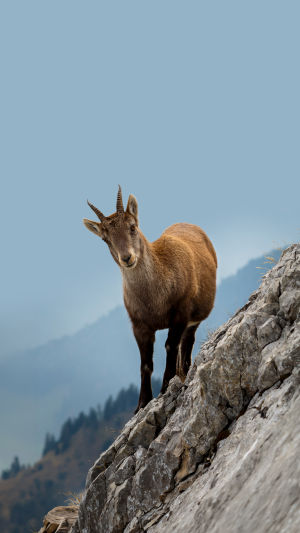
Hello Lykkers! High in the rocky mountains of Europe, Asia, and parts of Africa, ibex move with a confidence that seems almost impossible. They do not merely live on cliffs; they treat steep walls, narrow ledges, and broken ridges as if they were ordinary ground.
That reputation is well earned. Ibex are among the most specialized mountain animals on Earth, built by evolution for balance, traction, and survival in places where many large mammals would struggle to stand, let alone climb.
<h3>Built for Vertical Worlds</h3>
An ibex is perfectly engineered for life on steep mountains. Unlike animals that rely on speed across open ground, it depends on precision, stability, and strength. Its most impressive adaptation is its split hoof. Each hoof has two flexible toes that spread apart slightly when stepping onto uneven rocks, increasing contact with the surface.
The hard outer edge grips tiny ledges, while the soft, rubber-like pad underneath creates friction against smooth stone. This combination allows the animal to maintain traction on surfaces that appear almost impossible to stand on. Powerful forelegs and hind legs work together to propel the ibex upward with surprising ease. Strong shoulder and leg muscles generate explosive jumps between rocky outcrops, while flexible joints absorb the impact when landing on narrow footholds.
<h3>Remarkable Balance Keeps Every Step Secure</h3>
Balance is just as important as strength. Ibexes constantly adjust their posture to keep their center of gravity over the rock beneath them. Even while standing on ledges only a few centimeters wide, they distribute their weight carefully across all four limbs. Their hooves grip independently, allowing each foot to adapt to uneven angles without disturbing the others.
This remarkable coordination enables ibexes to make rapid decisions while climbing. Instead of hesitating before every step, they evaluate the terrain almost instantly and move with fluid precision. Young ibexes begin developing these skills shortly after birth. Within days, newborn kids are already following their mothers across steep slopes, learning by observing experienced adults and gradually improving their own agility.
Alpine Ibex Masters of the Mountain Peaks | Gravity Defying Wild Goats
Wildlife Pedia English
<h3>Climbing Is Their Best Defense</h3>
One of the main reasons ibexes evolved such impressive climbing abilities is survival. Mountain predators, including wolves, lynx, snow leopards in parts of Asia, and golden eagles that may threaten young kids, are far less capable of navigating sheer cliffs. When danger approaches, ibexes retreat to rocky escarpments where pursuing predators struggle to maintain footing.
Instead of relying solely on speed, they use terrain as their greatest defense. By reaching inaccessible ledges, they dramatically reduce the chances of being caught. This strategy has helped ibex populations survive for thousands of years in mountainous ecosystems where predators remain an important part of the natural food web.
<h3>Surviving Where Food Is Scarce</h3>
Mountain landscapes rarely provide abundant vegetation. The growing season is short, winters are long, and many slopes remain covered with snow for months. Ibexes overcome these challenges by feeding on a wide variety of alpine plants, including grasses, herbs, mosses, shrubs, lichens, and the leaves of hardy mountain vegetation. Their climbing ability allows them to reach feeding areas that remain inaccessible to most grazing mammals.
During warmer months, they often move to higher elevations where fresh alpine plants emerge after snowmelt. As winter approaches, many populations descend to lower slopes where snow is less severe and food remains available. This seasonal movement helps them make the most of limited mountain resources throughout the year.
The ibex is far more than an excellent climber—it is one of nature's finest examples of adaptation to extreme environments. Flexible hooves, extraordinary balance, powerful muscles, and keen spatial awareness allow it to move confidently across cliffs that appear impossible to scale. Every climb reflects millions of years of evolution shaped by survival in rugged mountain landscapes.


