

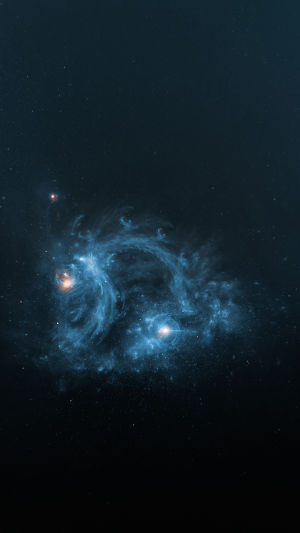
Hello, Lykkers! Strap in, because the universe has a demolition derby scheduled, and we've got front-row seats.
Actually, more like we're one of the cars. Our very own Milky Way is barreling toward the Andromeda Galaxy at about 250,000 miles per hour.
That's like a family sedan doing donuts in a parking lot, except the parking lot is 2.5 million light-years wide, and the sedan is a trillion stars. Astronomers have known for a while that we're on a collision course, and new data from the Hubble Space Telescope suggests the impact might come sooner than anyone thought. So let's talk about the biggest fender bender in cosmic history.
First off, don't panic. You won't be around to see it. This thing happens over millions of years, not something you'll catch on your evening commute. But the science behind it is wild. The two galaxies are being pulled together by gravity, and they're currently about 2.5 million light-years apart.
That sounds like a safe distance, but in space terms, that's practically tailgating. The Hubble observations show the two galaxies are closing in faster than previously estimated, which means the big merge could happen in about 4 billion years. That's a long time, but in the grand clock of the universe, it's like realizing your friend is about to bump into you at a party in the next five seconds, not five minutes.
<h3>What Will Happen When They Meet</h3>
When the galaxies start to tangle, it's not like two clumps of stars smashing into each other. Space is mostly empty, so the stars themselves will mostly sail right past each other. The real action is in the gas clouds and dust. These huge, wispy clouds will slam together, compress, and ignite into a frenzy of new star formation.
Imagine shaking a can of soda and then opening it, except the soda is hydrogen and the fizz is millions of newborn stars. It's going to be a spectacular light show. But the real mess is gravitational. The two galaxies will get stretched and torn, flinging stars into long, looping tails.
Our own sun could get thrown into a new orbit, maybe even out into intergalactic space. Still, Earth and the sun will probably be fine, though the sky will look completely different.
<h3>The Eventual Super-Galaxy</h3>
After billions of years of dancing and spiraling, the two galaxies will eventually settle into one giant elliptical galaxy. Astronomers have already nicknamed it "Milkomeda." It will be a huge, round blob of stars, nothing like the flat, spiral disk we live in now. And it won't stop there.
The new galaxy will keep gobbling up smaller neighbors, like the Triangulum Galaxy and a bunch of dwarf galaxies that orbit us. Over time, Milkomeda will become the dominant structure in our local corner of the universe. Eventually, it might even merge with the other nearby giant, the Virgo Cluster.
So basically, our little galactic family is going to get absorbed into a bigger and bigger family until it's all just one giant, star-filled blob. The cosmic circle of life, if you will.
<h3>What This Means for Us</h3>
For us living right now, it's just a fun fact to drop at a dinner party. But for any future civilizations that might exist in a few billion years, they'll witness a sky that's completely transformed. The Milky Way's familiar band across the night sky will be gone, replaced by a chaotic swirl of new stars and twisted arcs of gas.
And if any of them look back at old records from our time, they'll see pictures of a calm, peaceful spiral galaxy, a ghost from a simpler era. But here's the thing: The universe is always moving, always changing. Nothing is permanent, not even our own galaxy. That's both humbling and strangely comforting.
So next time you look up at the stars, remember that those twinkling lights are on a cosmic road trip, and the destination is a colossal meetup.
Enjoy the view while it lasts, because in about 4 billion years, the night sky is going to get a whole lot more interesting. And Lykkers, that's a collision you don't want to miss. Keep your eyes on the skies and your feet on the ground. Until next time.


