

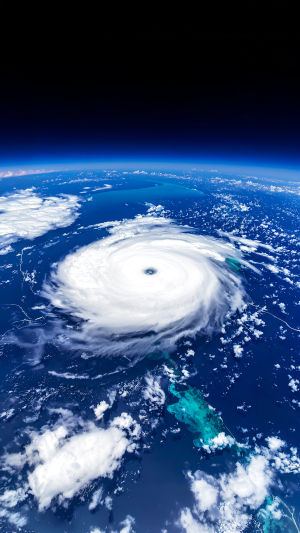
Hurricanes are among the most powerful weather systems on Earth, capable of producing intense winds, heavy rainfall, and significant coastal impacts.
In recent decades, scientists have studied changes in hurricane behavior, including stronger storms in some regions and faster periods of intensification. While natural climate patterns continue to influence these storms, rising ocean temperatures and changing atmospheric conditions are becoming important factors in understanding how hurricane intensity may change over time.
Modern technology has also transformed how scientists monitor and predict hurricanes. Satellites, advanced computer models, and improved observation systems help researchers study how these storms develop and how future environmental changes may affect their strength.
<h3>Warmer Oceans Provide More Energy</h3>
Hurricanes develop over warm ocean waters, where heat and moisture provide the energy needed to support their circulation. As ocean temperatures increase, more energy can become available for storms to intensify when other conditions are favorable.
Warm water increases evaporation, sending more moisture into the atmosphere. When this moisture condenses inside a hurricane, it releases heat that can strengthen the storm’s internal circulation and support more powerful winds.
Scientists explain that warmer ocean temperatures do not create every hurricane, but they can increase the potential for storms to become more intense under suitable environmental conditions.
<h3>Changing Atmospheric Conditions Influence Storm Growth</h3>
A hurricane’s strength depends on more than ocean temperature. Atmospheric conditions, including wind patterns and air circulation, also play a major role in storm development.
When winds at different levels of the atmosphere change significantly, they can disrupt a hurricane’s structure and limit its ability to strengthen. However, when atmospheric conditions are more supportive, storms can maintain their organization and potentially become more powerful.
Changes in atmospheric patterns can also influence hurricane movement, duration, and rainfall levels.
<h3>Rapid Intensification Creates New Challenges</h3>
Rapid intensification is one of the most important areas of hurricane research. This process occurs when a hurricane increases in strength significantly within a short period.
Scientists continue to study why some hurricanes experience rapid intensification and how warmer ocean conditions may contribute to this process. Faster changes in storm strength can make forecasting more difficult because preparation time may become shorter before a storm reaches dangerous levels.
Improved prediction systems are helping researchers better understand these changes and provide more accurate warnings.
<h3>Technology Improves Hurricane Research</h3>
Advancements in technology have greatly improved how scientists observe and study hurricanes. Weather satellites provide detailed information about storm movement, cloud structures, and ocean conditions.
Computer models allow researchers to simulate possible hurricane paths and analyze how storms may respond to changing environmental conditions. Aircraft observations and ocean monitoring systems also provide valuable information from within and around hurricanes.
These tools help improve forecasts, support scientific research, and strengthen preparation strategies for communities affected by severe weather.
<h3>The Role of Climate Research</h3>
Climate scientists continue investigating how long-term environmental changes influence hurricane behavior. Research suggests that warmer conditions can increase the amount of rainfall produced by hurricanes and may contribute to a higher possibility of stronger storms in certain areas.
However, hurricanes are complex systems affected by many interacting factors. Scientists continue examining how ocean conditions, atmospheric patterns, and natural climate variations work together to influence storm intensity, frequency, and movement.
<h3>Preparing for Future Hurricanes</h3>
As hurricane science continues to advance, understanding storm behavior becomes increasingly important. Improved observation systems, more accurate forecasts, and better preparation methods can help communities respond more effectively during extreme weather events.
By studying ocean temperatures, atmospheric conditions, and hurricane development, scientists are building a clearer understanding of how these powerful storms may change in the future.
Hurricanes remain a major focus of scientific research because their strength is influenced by a combination of ocean conditions, atmospheric changes, and climate patterns. Warmer oceans can provide additional energy for storms, while advanced technology helps researchers monitor and understand these complex weather systems. Continued scientific investigation will be essential for improving hurricane forecasts and preparing for future changes in storm behavior.


