

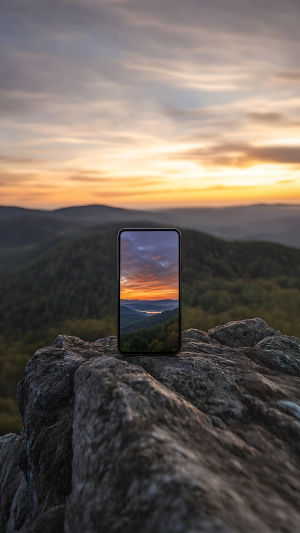
Hi, Friends! You know that feeling when your friend whips out their phone and takes a photo so gorgeous you briefly forget they're not a professional photographer?
Yeah, that's been happening more and more lately, and it's not just your imagination. Smartphone cameras have been quietly going through a serious glow-up, and the gap between your phone and a big chunky professional camera is shrinking like a wool sweater in a hot dryer.
<h3>It All Starts With the Sensor</h3>
The sensor is basically the camera's eyeball - it's what captures light and turns it into a photo. For a long time, phone sensors were tiny little things that struggled in dim light like a student trying to read without glasses. But modern smartphones are now packing larger sensors that can grab more light, which means better detail, less graininess, and photos that don't look like they were taken through a foggy window. Some flagship phones now use sensors that are genuinely comparable in size to entry-level dedicated cameras. That's a huge deal.
<h3>Computational Photography Is the Secret Advantage</h3>
Here's where phones pull off their sneakiest trick. Professional cameras rely on hardware - big lenses, massive sensors, and lots of glass. Phones, on the other hand, cheat cleverly using software. This is called computational photography, and it's basically your phone's brain doing insane amounts of math to make your photos look better. Night mode? That's your phone taking multiple exposures and stacking them together so fast you don't even notice. Portrait mode with that dreamy blurred background? The phone is using depth sensors and AI to figure out where you end up and where the background begins, then blurs accordingly. It's like having a tiny invisible photo editor living inside your phone, working overtime every time you tap the shutter button.
<h3>Multiple Lenses Mean More Versatility</h3>
Remember when phones had one camera and that was that? Now they're showing up to the party with three, four, sometimes even five lenses. You've got your wide-angle for landscapes, your main lens for everyday shots, and a telephoto lens for zooming in on things without making your photo look like a grainy mess. This multi-lens system mimics what professional photographers do when they carry a whole bag full of different lenses - except now it all fits in your pocket next to your keys and some old receipts.
<h3>Optics Have Gotten Seriously Impressive</h3>
Lens quality has quietly been leveling up too. Optical image stabilization (OIS) is now standard on most decent phones, which means even if your hands are shakier than a chihuahua in a thunderstorm, your photos come out crisp and clear. Aperture sizes have improved, letting in more light without making everything look overexposed. Some phones are even partnering with legendary camera brands to fine-tune their color science and lens coatings, which is basically like getting a Michelin-star chef to season your instant noodles.
<h3>AI Is Doing the Heavy Lifting</h3>
Artificial intelligence has basically become the co-pilot of smartphone photography. The phone recognizes what you're shooting - a sunset, a plate of food, a pet, a person - and automatically adjusts settings to make it look its best. It detects faces and makes sure they're perfectly exposed. It identifies scenes and boosts the right colors. It even cleans up noise in low-light photos in real time. A professional photographer does all of this manually using years of experience and skill. Your phone just does it instantly, like a very enthusiastic assistant who never sleeps.
<h3>RAW Shooting Closes the Final Gap</h3>
For the more serious photography enthusiasts out there, many smartphones now support shooting in RAW format. This means the phone saves all the unprocessed image data straight from the sensor, just like a professional camera would. You then get to edit it yourself with full control over exposure, color, and detail. This is the phone saying, "Okay, you want to play in the big leagues? Here you go."
So the next time someone gives you side-eye for using your phone instead of a "real" camera, just smile and show them the results. The technology in your pocket is genuinely remarkable, and it keeps getting better with every new release. Give your phone camera a proper chance - experiment with modes, play with lighting, and don't be afraid to get creative. You might just surprise yourself with what you can create!


