

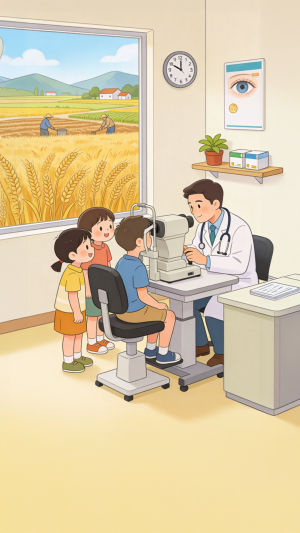
Clear vision plays a fundamental role in how children discover the world, interact with others, and succeed in everyday activities.
Reading a favorite story, recognizing faces across a classroom, catching a moving ball, or drawing colorful pictures all depend on healthy visual development.
Yet many vision problems develop gradually and may not be obvious to families or teachers. Because children often assume everyone sees the world the same way, reduced vision can remain unnoticed for years.
<h3>Purpose of Vision Screenings</h3>
A vision screening is a quick assessment designed to identify children who may need a comprehensive eye examination. Unlike a complete examination performed by an eye care professional, a screening does not diagnose specific conditions. Instead, it evaluates whether visual performance falls within the expected range for a child's age.
Most screenings measure visual clarity at different distances, evaluate how well both eyes work together, and sometimes assess depth perception or color recognition. Modern screening programs may also use digital devices that estimate focusing errors without requiring children to identify letters or symbols. Although screenings are simple and noninvasive, they serve as an effective first step in recognizing potential vision concerns before noticeable symptoms appear.
<h3>Why Early Detection Matters</h3>
Visual development continues throughout early childhood, making timely identification especially valuable. Certain conditions respond more effectively to early intervention because the visual system is still developing rapidly. Undetected vision problems may influence reading ability, classroom participation, concentration, hand-eye coordination, and confidence during learning activities.
Some children compensate remarkably well by moving closer to books, tilting their heads, or relying more heavily on one eye, making the underlying issue difficult to recognize without screening. Identifying concerns early allows appropriate intervention while visual pathways are still developing, supporting healthy long-term visual function. As Princess Ifeoma Ike and Dr. Chimeziri Anderson noted, "The ability to see clearly is fundamental to a child's development, education and overall well-being." Their observation highlights the importance of recognizing potential vision concerns as early as possible to support healthy visual development and learning.
<h3>Common Conditions That Screenings Can Detect</h3>
- Nearsightedness (myopia) makes distant objects appear blurry while nearby objects remain clear. Its prevalence has increased worldwide, partly due to lifestyle changes involving prolonged close work and reduced outdoor activity.
- Farsightedness (hyperopia) can cause difficulty maintaining clear focus during reading or other close tasks, particularly when the focusing demand becomes prolonged.
- Astigmatism occurs when the front surface of the eye has an irregular curvature, causing light to focus unevenly and reducing image sharpness.
Screenings may also identify differences in vision between the two eyes or reveal signs that suggest the eyes are not working together efficiently. Although additional evaluation is necessary for diagnosis, early referral provides an opportunity for timely management.
<h3>Signs That Should Never Be Ignored</h3>
Even when routine screenings are scheduled, certain behaviors deserve prompt attention. Frequent squinting, persistent eye rubbing without irritation, excessive blinking, covering one eye while reading, unusually close viewing of books or screens, or repeated complaints about blurred vision may indicate that further assessment is needed.
Children experiencing headaches after visual tasks, losing their place while reading, or avoiding activities requiring detailed focus may also benefit from a professional examination. In many cases, these behaviors develop gradually, making careful observation especially valuable. Teachers often notice subtle classroom patterns before families do, highlighting the importance of communication between school and home.
<h3>What Happens During a Vision Screening?</h3>
Vision screenings are designed to be comfortable and efficient. Younger children may identify pictures, symbols, or matching shapes rather than reading letters. Older children usually complete standard visual acuity charts that evaluate distance vision. Some screening devices analyze how light reflects inside the eye, estimating refractive errors within seconds. These instruments are particularly useful for children who are too young to respond verbally during traditional testing.
The procedure generally requires only a few minutes and does not involve discomfort. If results suggest a possible concern, referral for a comprehensive eye examination provides a more detailed assessment of visual health and function.
<h3>Supporting Healthy Visual Development</h3>
Healthy daily habits contribute to comfortable vision throughout childhood. Encouraging regular outdoor play has been associated with a reduced likelihood of developing myopia in several scientific studies. Adequate lighting during reading, balanced nutrition rich in vitamins and antioxidants, and appropriate screen-time habits also support visual comfort.
The widely recommended 20-20-20 guideline can help reduce temporary eye strain during prolonged near work. After every 20 minutes of close viewing, look at an object approximately 20 feet away for at least 20 seconds to allow the focusing system to relax. Regular eye examinations remain important even when previous screenings have been normal, as visual changes can develop as children grow.
Vision screenings are a valuable part of protecting children's visual development. Although they do not replace comprehensive eye examinations, these quick assessments help identify potential concerns before noticeable symptoms begin affecting learning, confidence, and everyday experiences. Combined with careful observation, healthy visual habits, and professional follow-up when needed, vision screenings support healthy visual development throughout childhood.


