

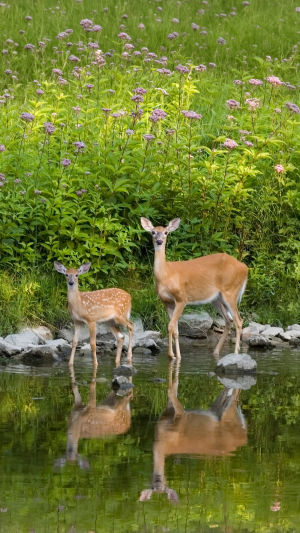
Have you ever seen a deer suddenly disappear into the forest with its bright white tail raised?
This simple movement is one of nature’s most effective warning signals. It belongs to the white-tailed deer, one of the most widespread and adaptable mammals in North and South America.
This article explores how these animals live, communicate, survive, and adapt to changing environments.
<h3>What Makes White-Tailed Deer Easy to Recognize?</h3>
The white-tailed deer (Odocoileus virginianus) is named for the white underside of its tail, which becomes highly visible when raised. This is used as a warning signal to other deer when danger is near.
Their coat changes with the seasons. In warmer months, it appears reddish-brown, helping them blend into vegetation. In colder months, it turns grayish-brown, offering better camouflage in forests and dry landscapes.
White-tailed deer also have horizontal pupils and color vision that is more sensitive to blues and yellows. They have difficulty distinguishing reds and oranges, which affects how they perceive their environment.
<h3>Size and Physical Features</h3>
White-tailed deer vary in size depending on region and climate. Deer in colder regions tend to grow larger than those in warmer areas.
Male white-tailed deer (bucks) typically reach about 6 to 8 feet in length and stand 2 to 4 feet tall at the shoulder. Their weight commonly ranges between 150 and 300 pounds.
Females (does) are smaller, generally weighing between 88 and 200 pounds.
Their long legs and strong muscles allow them to run fast, jump high, and move efficiently through forests and uneven terrain.
<h3>Antler Growth Cycle</h3>
One of the most remarkable features of male white-tailed deer is their antlers.
Each spring, antlers begin to grow and are covered in a soft, nutrient-rich tissue known as velvet. As the antlers fully develop, the velvet is shed.
After the breeding season, typically in late winter, the antlers naturally fall off. The cycle then repeats each year.
Antler size and shape depend on age, nutrition, and genetics, with healthier environments supporting more developed antlers.
<h3>Habitat and Distribution</h3>
White-tailed deer are found across a wide geographic range, from Canada through the United States and into parts of Central and South America.
They inhabit forests, grasslands, wetlands, agricultural areas, and even suburban environments. Their ability to adapt to human-altered landscapes has helped their population remain stable in many regions.
<h3>Diet and Feeding Habits</h3>
White-tailed deer are herbivores. Their diet changes with the seasons and includes grasses, leaves, shoots, fruits, nuts, and agricultural crops.
They are most active during early morning and evening hours.
As ruminants, they have a four-chambered stomach that allows them to efficiently digest plant material with the help of specialized microorganisms.
Sudden changes in diet can affect their digestive health, so natural feeding patterns are important for their well-being.
<h3>Defense and Survival Strategies</h3>
White-tailed deer rely on sharp senses and quick movement to avoid predators. Their hearing and sense of smell are highly developed.
When threatened, they may stomp the ground, raise their tail to signal danger, and flee quickly using powerful leaps.
Living in groups also increases their awareness, as multiple deer can watch for potential threats while others feed.
<h3>Ecological Importance</h3>
White-tailed deer play an important role in ecosystems. They help shape plant growth through grazing and contribute to seed dispersal.
Their movement across landscapes also creates natural pathways used by other wildlife.
Because they are widely distributed, they are often studied to understand wildlife behavior and ecosystem balance.
White-tailed deer are highly adaptable animals with unique survival strategies. From seasonal coat changes to their iconic tail signals, every feature supports their ability to survive in diverse environments.
A brief glimpse of a white tail disappearing into the forest is more than a moment of beauty—it is a glimpse into a highly evolved system of communication and survival.


