

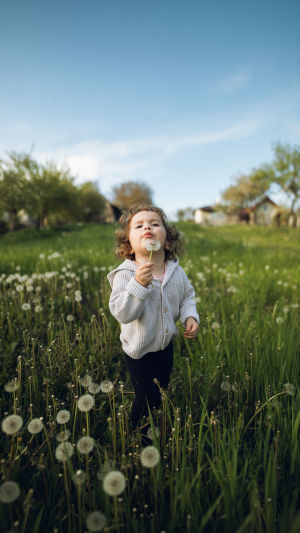
Have we ever paused to observe a tiny dandelion seed drifting through the air? It moves gently, without rush or fixed direction, yet it still finds its place in the world. In many ways, a child’s growth can feel similar.
Today, we reflect on a simple idea: children grow best when they are understood, not overly directed. Let us explore this thought in a calm and thoughtful way.
<h3>Children as Natural Dandelion Seeds in Motion</h3>
We can imagine each child as a floating dandelion seed carried by a gentle wind. Some travel far, some stay close, and some land quickly. Yet each journey is unique and meaningful.
From the beginning of life, children show different interests and rhythms. Some are drawn to sounds, others to colors, movement, or quiet observation. These early signs are not random—they reflect their natural direction of growth.
When we accept this perspective, we begin to understand that growth is not about forcing a single path, but about discovering the one that already exists within each child.
<h3>When Care Becomes Too Restrictive</h3>
In family life, guidance often comes from care, responsibility, and hope. Many adults want to help children avoid uncertainty and build a stable future. Because of this, plans and expectations may be set very early.
Children may be guided toward specific activities, routines, or outcomes. While these intentions are usually rooted in love, excessive control can gradually reduce curiosity.
Instead of exploring freely, children may begin to focus only on meeting expectations. Over time, learning can feel less natural and more pressured.
<h3>Listening to Inner Interests</h3>
Every child has an inner sense of curiosity that reveals what they naturally enjoy. It may appear in small behaviors: repeated drawing, frequent questioning, or strong interest in building and creating.
These signs are important. They show where a child’s energy naturally flows. When we observe them carefully, we gain better understanding of what supports healthy growth.
Rather than replacing this inner direction, it is more effective to recognize it and provide gentle support.
<h3>The Impact of Over-Control</h3>
When every step is planned in advance, children may lose opportunities to make simple decisions on their own. This can affect how they develop confidence in their choices.
Growth is not a straight line. It includes exploration, trial, adjustment, and discovery. When these experiences are reduced, learning becomes incomplete.
Like dandelion seeds unable to follow the wind, children may struggle to feel connected to what they are doing. Even when they succeed, the joy of discovery may be missing.
<h3>Guidance as a Gentle Light</h3>
A balanced approach is to guide rather than control. Guidance is like a soft light in the background—it supports without blocking the path.
We can ask questions instead of giving fixed instructions. We can offer choices instead of strict directions. We can listen before responding.
For example, if a child shows interest in nature, we can offer opportunities to observe and explore. If creativity is expressed, we can provide tools and space without defining the outcome.
In this way, children feel supported while still having room for independent growth.
<h3>Learning Through Experience</h3>
Small experiences, including mistakes and adjustments, are essential parts of learning. They help children understand how the world works and how they relate to it.
When children try something new, they learn not only outcomes but also processes. This builds patience, awareness, and resilience.
If every step is corrected too early, valuable learning moments may be lost. Allowing space for experience helps children develop stronger thinking and emotional balance.
<h3>Respecting Different Growth Speeds</h3>
Not every child grows at the same pace. Some develop certain abilities earlier, while others need more time. Both are completely natural.
Respecting these differences helps create a healthier learning environment. It reduces unnecessary comparison and allows children to focus on their own progress.
When we accept different growth speeds, we create more room for confidence and self-trust to develop.
<h3>Allowing Growth to Unfold Naturally</h3>
Children are not projects to be shaped, but individuals to be understood.
Their paths do not need to be fully designed in advance. Instead, they need space, attention, and trust.
When we step back and observe carefully, we often see that children naturally move toward what suits them best. Like dandelion seeds carried by the wind, they find their own place in time.
Let us support their growth with patience, awareness, and openness. And perhaps we can also reflect on this question: are we trying to control the wind, or are we learning to trust its direction?


