

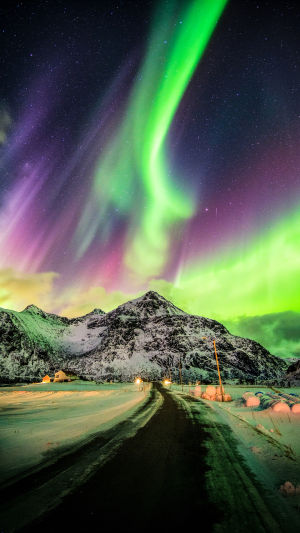
Few natural phenomena are as captivating as an aurora. Brilliant waves of green, red, violet, and blue can illuminate the night sky, creating displays that appear almost otherworldly.
Although auroras have fascinated people for centuries, scientists now understand the physical processes responsible for their formation. These remarkable lights reveal the ongoing interaction between the Sun, Earth's magnetic field, and the atmosphere above our planet.
<h3>The Sun Starts the Process</h3>
Auroras begin at the Sun. The Sun continuously releases a stream of electrically charged particles into space known as the solar wind. Most of these particles are deflected by Earth's magnetic field, which acts as a protective shield around the planet.
However, some particles become trapped within the magnetic field and are guided toward the polar regions, where they enter the upper atmosphere.
<h3>Why Auroras Form Near the Poles</h3>
Earth's magnetic field directs charged particles toward two oval-shaped regions surrounding the magnetic poles. As a result, auroras occur most frequently near the North Pole and South Pole.
The northern display is called the aurora borealis, while the southern display is known as the aurora australis. During periods of strong solar activity, auroras can sometimes be seen much farther from the poles than usual.
<h3>What Creates the Glow</h3>
When solar particles collide with atoms and molecules in the upper atmosphere, energy is transferred to those particles. This causes electrons to move to higher energy states.
As the electrons return to their normal states, they release excess energy in the form of light. The combined effect of countless collisions creates the glowing curtains, arcs, and waves visible during an aurora.
<h3>Why Auroras Move</h3>
Auroras are not stationary. Their flowing shapes and shifting patterns are controlled by Earth's magnetic field lines.
As charged particles travel along these invisible pathways, the light appears to ripple and dance across the sky, producing the dynamic movements that make auroras so distinctive.
<h3>The Meaning Behind the Colors</h3>
Different atmospheric gases produce different colors when energized by incoming particles.
Green, the most common auroral color, is produced by oxygen atoms at altitudes of roughly 60 to 150 miles above Earth's surface.
Red auroras are also produced by oxygen but occur at much higher altitudes. Blue, violet, and pink colors are primarily generated by nitrogen.
The combination of altitude, atmospheric composition, and particle energy determines the colors visible in an auroral display.
<h3>When Auroras Become More Visible</h3>
The Sun experiences an activity cycle that lasts approximately 11 years. During periods of increased solar activity, larger numbers of charged particles reach Earth.
As a result, auroras become brighter, more frequent, and visible across wider regions. Some particularly strong events allow auroras to be observed far beyond their usual polar locations.
<h3>Auroras Beyond Earth</h3>
Auroras are not unique to Earth. Several planets with atmospheres and magnetic fields also experience similar displays.
Jupiter, Saturn, Uranus, and Neptune all have confirmed auroral activity. Mars also experiences aurora-like events, although its lack of a strong global magnetic field causes them to behave differently from those seen on Earth.
Auroras are the visible result of an ongoing interaction between the Sun and Earth's atmosphere. Charged particles traveling across space collide with atmospheric gases, producing brilliant displays of light that follow the planet's magnetic field. These colorful phenomena provide a remarkable example of how processes occurring millions of miles away can create breathtaking effects in Earth's night sky.


