

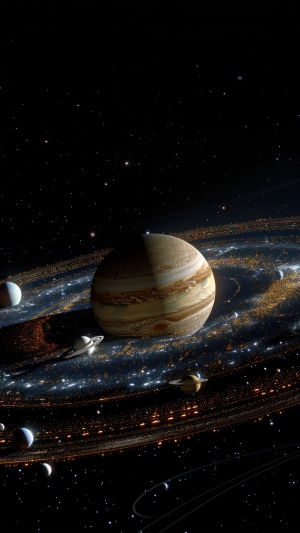
Hello Lykkers! When we look at the night sky, it is natural to wonder why Earth only has one Moon, while Jupiter has dozens of moons surrounding it.
This difference feels huge, but it is actually the result of how the Solar System was built step by step over billions of years. To understand it clearly, we need to go back to the very beginning of planetary formation.
<h3>Two Planet Families in the Solar System</h3>
In the Solar System, planets can be grouped into two main types. The inner planets are small, rocky, and dense. They formed closer to the Sun, where temperatures were high and light materials could not easily stay.
The outer planets are very different. They are much larger and mainly made of gas and ice. These planets formed in colder regions where more materials could gather together. Because of this difference, they had very different abilities when it comes to holding natural satellites.
<h3>A Spinning Cloud Begins Everything</h3>
About 4.5 billion years ago, the Solar System started as a huge cloud of gas and dust. Gravity slowly pulled this cloud inward. As it collapsed, it began to spin and flatten into a disk around the young Sun.
Inside this disk, tiny particles collided and stuck together. Over time, they formed larger and larger bodies. In the inner region, heat from the Sun made it difficult for light materials like ice to survive, so only rocky and metallic materials remained dominant.
This is why inner planets stayed relatively small and compact.
<h3>Why Outer Planets Became Moon Collectors</h3>
Farther from the Sun, conditions were much colder. Ice, rock, and metal could all exist together. This allowed much larger objects to form. As these objects grew, their gravity became stronger and stronger.
Once they became massive enough, they could pull in nearby passing objects. Some of these objects were formed nearby, while others were captured as they moved through space.
This is one of the main reasons Jupiter and other outer planets ended up with so many moons.
<h3>Gravity Games in Deep Space</h3>
The Sun’s gravity dominates the inner Solar System. That makes it difficult for small planets near the Sun to keep satellites. Objects are more likely to fall toward the Sun instead of staying bound to a planet.
However, as we move farther away, the Sun’s influence weakens. At the same time, large outer planets have very strong gravity of their own. This combination creates the perfect environment for capturing and holding many moons. Jupiter is the strongest example of this balance in action.
<h3>Famous Moon Systems Around Giant Planets</h3>
Jupiter has a large number of known moons. Some are small and irregular, while others are large and spherical. One of its biggest moons is even larger than Mercury, showing how powerful Jupiter’s system is.
Saturn also has many moons, including one with a thick atmosphere and active surface chemistry, making it very unique among all known satellites.
Uranus and Neptune also have multiple moons, though fewer compared to Jupiter and Saturn. Still, they follow the same basic pattern: large planets tend to collect more satellites.
<h3>Earth’s Special Case: One Moon Only</h3>
Earth is different from the giant outer planets. Its smaller size and closer position to the Sun limit its ability to capture and keep multiple satellites.
Most scientists believe Earth’s Moon formed after a massive early collision. A Mars-sized object struck the young Earth, sending material into orbit. Over time, this debris slowly came together to form the Moon.
This explains why Earth has only one natural satellite instead of many smaller ones.
<h3>Closing: A Sky Full of Stories</h3>
The difference between Earth and Jupiter is not random. It comes from distance, temperature, gravity, and early Solar System history working together in a complex way.
So when we look up at the Moon tonight, we are not just seeing a quiet companion. We are seeing the result of a dramatic ancient process that shaped our world.
Thanks for reading, Lykkers! What do you think—would Earth look very different if it had more moons?
Why Does Jupiter Have So Many Moons? | Unveiled
Video by Unveiled


