

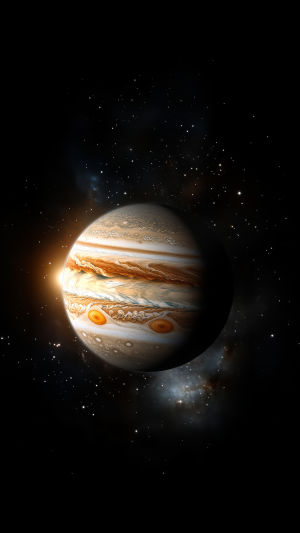
Hello Lykkers, today we step into one of the most powerful natural forces in our solar system. We often think of planets as quiet, distant worlds, but Jupiter tells a different story.
Around this giant planet, invisible forces move with incredible strength, shaping space itself. In this article, we explore how this massive magnetic environment works and why it matters for everything nearby.
<h3>A Field Born from Deep Inside</h3>
Inside Jupiter, pressure and heat create a special form of matter called liquid metallic hydrogen. As the planet spins very fast, this material moves like a vast, flowing conductor. This motion generates an extremely strong magnetic field.
Compared with Earth, Jupiter’s magnetic strength is on another level. It reaches roughly tens of thousands of times stronger than what we experience on our planet. This makes it the most powerful planetary magnetic system known in our solar system.
The fast rotation also plays a key role. A full spin takes only about ten hours, which helps the internal flow stay active and stable. Together, these conditions build a continuous energy-producing system deep within the planet.
<h3>A Vast Protective Region in Space</h3>
Around Jupiter lies a large magnetic region that stretches millions of kilometers into space. This zone acts like a shield, blocking much of the charged material coming from the Sun.
But this protection is not calm or simple. Inside this region, charged particles move at high speeds, guided by magnetic lines that loop around the planet. These particles create strong currents, forming a dynamic system that behaves almost like a natural power generator in space.
For spacecraft passing nearby, this environment can be challenging. Electronic systems need special protection because high-energy particles may interfere with onboard instruments. As a result, exploration missions require careful planning and shielding technology.
<h3>Light Displays Across the Poles and Beyond</h3>
One of the most striking features of Jupiter’s magnetic activity is its glowing light patterns near the poles. These bright emissions appear when energetic particles collide with gases in the upper atmosphere.
Unlike Earth, where such lights are mostly limited to polar regions, Jupiter shows a broader range of activity. Some glowing patterns can even appear in areas far from the poles, creating complex and shifting shapes.
These light displays offer scientists a visible clue about what is happening inside the magnetic environment. By observing them, we gain insight into how energy moves and interacts in space around the planet.
<h3>Influence on Nearby Moons</h3>
Jupiter does not exist alone. It has many moons, and some of them are strongly affected by its magnetic environment. Two of the most interesting are Europa and Io.
Europa has a thick icy surface, and beneath it, scientists believe there may be a hidden ocean of liquid water. Changes in magnetic signals around this moon help researchers study what lies below the surface without direct contact.
On the other hand, it is one of the most active volcanic worlds known. Its internal activity is influenced by both gravitational pull and magnetic interactions from Jupiter. This combination creates constant movement inside the moon, shaping its dramatic surface changes.
These moons act like natural laboratories, helping us understand how large planetary systems interact over time.
<h3>Why This System Matters for Science</h3>
Studying Jupiter’s magnetic environment gives us more than just information about one planet. It helps us understand how giant planetary systems behave across the universe.
We learn how internal motion can generate large-scale magnetic structures, and how those structures interact with surrounding space. This knowledge also supports future space missions, especially those designed to explore distant moons and complex environments.
One upcoming mission, designed to study Europa in detail, aims to gather more information about its surface and hidden layers. With improved instruments, scientists hope to better understand how magnetic signals reveal what lies beneath icy worlds.
<h3>Closing: A Living Space System We Continue to Discover</h3>
As we look at Jupiter, we see more than a distant giant. We see a dynamic system where motion, energy, and space interact constantly. Its magnetic environment shapes not only the planet itself but also its surroundings in surprising ways.
For Lykkers, this journey reminds us that space is not empty or still. It is full of movement and invisible forces waiting to be explored. The more we observe, the more we understand how complex and connected our solar system truly is.
JUPITER’S INVISIBLE SHIELD The Strongest Magnetic Field in the Solar System
Video by Legendary Monster World


