

Isaac Newton had a solid handle on gravity for a couple of centuries. Pull two masses together, calculate the force, done.
It worked well enough to land a spacecraft on the Moon. But Newton never actually explained what gravity is. He just described what it does.
Einstein came along and answered the deeper question, and the answer turned out to be genuinely strange.
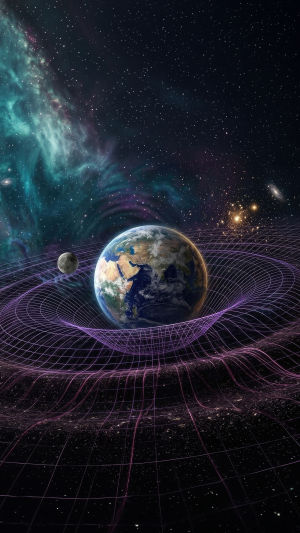
General relativity, published in 1915, is Einstein's explanation of gravity as geometry. Massive objects don't just pull on things around them. They warp the fabric of spacetime itself, and what we feel as gravity is actually objects following the curved paths created by that warping.
Picture a heavy ball sitting on a stretched rubber sheet. It creates a dip, and anything rolling nearby curves toward it. That's the basic idea, though the real math is considerably more involved.
<h3>Special Relativity Came First</h3>
A decade before general relativity, Einstein published special relativity in 1905. That theory dealt with simpler scenarios: no gravity, just objects moving at constant velocities relative to each other. The key insight was that the speed of light is constant for all observers, no matter how fast they're moving. That sounds harmless until you work out the consequences.
If light speed is fixed, then space and time have to be flexible. Two observers moving at different speeds will disagree on the length of an object and the time between two events. These aren't illusions. They're real physical differences.
Time passes more slowly for a fast-moving object than for a stationary one, a phenomenon called time dilation. And mass and energy are equivalent, connected by the most famous equation in physics: E = mc².
<h3>Gravity Warps Time, Not Just Space</h3>
General relativity extended these ideas to include gravity and acceleration. One of its predictions is that time doesn't just slow down with speed, it also slows down in stronger gravitational fields. The closer you are to a massive object, the slower your clock runs compared to someone farther away.
This isn't theoretical anymore. The GPS satellites orbiting Earth have atomic clocks on board, and those clocks tick at a slightly different rate than clocks on the ground. Engineers have to correct for both special and general relativistic effects to keep GPS accurate to the meter level. Without those corrections, location errors would accumulate by several kilometers per day. Every time you get a navigation direction, Einstein's physics is quietly running in the background.
<h3>What It Means for the Universe</h3>
General relativity also predicted gravitational waves, ripples in spacetime created when massive objects accelerate. These were confirmed directly when LIGO detected the merger of two black holes. It predicted that light from distant stars would bend around the Sun, which was confirmed during a solar eclipse shortly after the theory was published, making Einstein internationally famous practically overnight.
The theory also underpins our understanding of black holes, which form when matter is packed so densely that spacetime curves completely around it, and of the expanding universe, where the large-scale structure of the cosmos is governed by the same equations Einstein wrote down more than 100 years ago.
The theory has held up through every experimental test thrown at it. That's a remarkable run for a set of equations built on thought experiments about riding alongside a light beam.


