

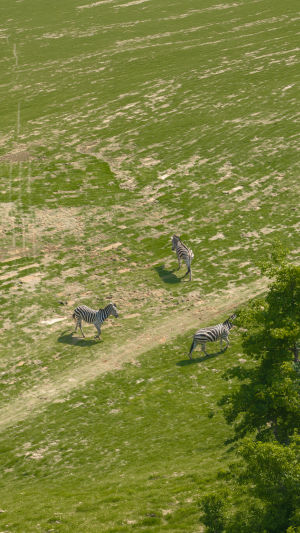
A herd moves across open savanna, their black-and-white patterns flickering like shifting shadows in sunlight.
At first glance, zebras seem almost designed for attention, yet their stripes are one of nature's most effective survival tools.
These animals belong to the equid family and live primarily in African grasslands, where adaptation is essential for survival.
<h3>The Mystery of Stripes</h3>
One of the most debated features in the animal world is the zebra's stripe pattern. No two zebras share the same arrangement, making each one visually unique.
Scientists suggest multiple functions behind this design:
- Heat regulation by influencing airflow over the body
- Visual confusion for insects, such as tsetse flies, that rely on landing accuracy
- Group camouflage when moving in herds
When zebras gather, their patterns blend into a moving visual field, making it harder for predators to target a single individual.
<h3>How Zebras Communicate</h3>
Zebras rely on a mix of body language, vocal sounds, and ear positioning to communicate within the herd.
- Ear direction signals attention or caution.
- Tail movement reflects mood and alertness.
- High-pitched calls help maintain group cohesion over distance.
These signals allow herds to stay coordinated even in wide, open landscapes where visibility is constantly changing.
<h3>Life in Constant Movement</h3>
Zebras are highly mobile animals. They often travel in search of fresh grazing areas and water sources, sometimes covering long distances depending on seasonal conditions.
Their movement patterns are closely linked to environmental cycles, ensuring access to resources while avoiding overgrazed regions.
<h3>Social Structure and Protection</h3>
Herd life plays a crucial role in survival. Zebras form stable groups that provide protection against predators and improve navigation across large territories.
<b>1.</b> Groups are typically led by a dominant male.
<b>2.</b> Females and young members form the core of the herd.
<b>3.</b> Collective movement reduces individual risk during migration.
This structure allows the herd to react quickly to environmental threats.
<h3>Speed and Agility</h3>
Zebras are built for sudden bursts of speed rather than long-distance endurance. Their strong limbs allow them to escape danger quickly, often running in zigzag patterns to confuse pursuers.
Their body structure supports rapid acceleration and quick directional changes, which is essential for survival in open grasslands.
<h3>Adaptation to Harsh Environments</h3>
Living in savanna ecosystems requires flexibility. Zebras can survive in areas with fluctuating rainfall and changing vegetation.
Their digestive system is adapted to process coarse grasses that many other herbivores avoid. This reduces competition for food resources and allows them to occupy a unique ecological role.
<h3>Differences Among Species</h3>
There are several zebra species, each adapted to specific environments:
- Plains zebras: most widespread and commonly seen in open grasslands
- Mountain zebras: adapted to rocky terrain with strong climbing ability
- Grevy's zebras: larger, with narrower stripes and adapted to arid regions
Each type reflects subtle environmental specialization.
<h3>Why Zebras Fascinate Scientists</h3>
Despite extensive research, zebras still present unanswered questions, especially regarding stripe evolution. The combination of visual complexity, social behavior, and ecological adaptation makes them a continuing subject of study in biology and animal behavior research.
Their survival strategy is not based on strength alone, but on coordination, movement, and visual interaction within the herd.
<h3>A Pattern That Still Raises Questions</h3>
Zebras are more than recognizable stripes on a landscape. They are part of a dynamic system where movement, communication, and environmental adaptation work together. Every herd crossing the savanna represents a balance between individuality and collective survival, shaped by one of nature's most distinctive visual designs.


