

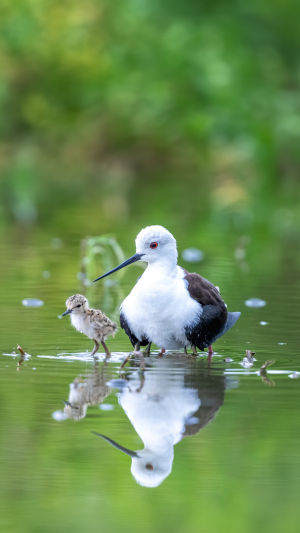
Standing in shallow water, the Black-winged Stilt often looks almost unreal at first glance. With its extremely long pink legs, slim body, and striking black-and-white contrast, it appears like a living sketch placed carefully into a calm wetland scene.
Beyond this striking beauty, however, lies a highly adapted species, perfectly shaped by its environment.
<h3>Built for shallow waters and delicate movement</h3>
The most remarkable feature of the Black-winged Stilt is its unusually long legs. These legs allow it to walk through shallow water with ease, keeping its body safely above wet surfaces while exploring feeding areas that many other birds cannot reach.
Its body is light and streamlined, designed for balance and efficiency. The contrast between black wings and a white body makes it visually bold, especially in open landscapes where water, mud, and sky reflect around it. This simple color pattern is not only attractive but also practical, helping it blend into shifting reflections and open environments.
<h3>Careful feeding and precise hunting</h3>
The Black-winged Stilt feeds mainly on small aquatic creatures, insects, and tiny organisms found in shallow water or soft mud. Instead of rushing, it moves slowly and carefully, scanning the surface with patience.
We can often see it pause frequently, tilt its head slightly, or gently tap the water before making a quick movement to catch food. This methodical behavior helps it save energy while increasing feeding success. Its long legs allow it to reach deeper areas without disturbing the water too much, giving it access to hidden food sources.
<h3>Efficient flight and elegant posture</h3>
When taking off, the Black-winged Stilt creates a striking image. Its long legs stretch straight backward, forming a clean and aerodynamic shape. This posture reduces air resistance and allows for smooth, efficient flight.
In the air, its movement is steady and controlled rather than fast or aggressive. It often appears to glide effortlessly across the sky, almost like a dancer suspended in motion. Even in flight, it maintains a sense of calm balance and precision.
<h3>Group living and shared protection</h3>
These birds are often seen in small groups or larger flocks, especially during migration periods or breeding seasons. Living together increases safety, as many eyes can detect danger more quickly.
When one bird senses a threat, it quickly alerts the others, and the group responds immediately by taking flight. This collective awareness helps reduce risk and improve survival chances.
During breeding seasons, pairs share responsibilities. Both parents take turns guarding the nest and caring for their eggs. This teamwork strengthens the success of the next generation and reflects a strong cooperative behavior within the species.
<h3>Adaptation across changing environments</h3>
The Black-winged Stilt is highly adaptable and can live in a variety of wetland environments, including shallow coastal areas, lagoons, and freshwater marshes. Its ability to adjust to different water conditions allows it to survive in changing landscapes.
Seasonal movement is also part of its life cycle. Depending on climate and food availability, it may travel between regions to find suitable feeding and breeding grounds. These journeys require endurance and careful energy use, showing how well adapted it is to long-distance movement.
<h3>Nature’s engineering of balance and function</h3>
Every feature of the Black-winged Stilt serves a clear purpose. The long legs support feeding in deeper shallow water. The contrasting feathers help with visual protection. The flight posture improves aerodynamic efficiency. The group behavior enhances safety and survival.
Nothing is accidental in its design. Over time, natural adaptation has shaped it into a highly efficient and elegant species. It is a living example of how function and beauty can evolve together in perfect balance.
<h3>A quiet lesson from the wetlands</h3>
Lykkers, the Black-winged Stilt shows us that elegance in nature is not just about appearance. It is deeply connected to survival, adaptation, and efficiency. Every movement it makes in shallow water reflects careful design shaped by time.
When we next observe a wetland scene, we may notice this tall, delicate bird standing still like a quiet sculpture. But behind that stillness is a story of precision, cooperation, and resilience. It reminds us that nature often hides its most intelligent designs in the simplest forms.


