

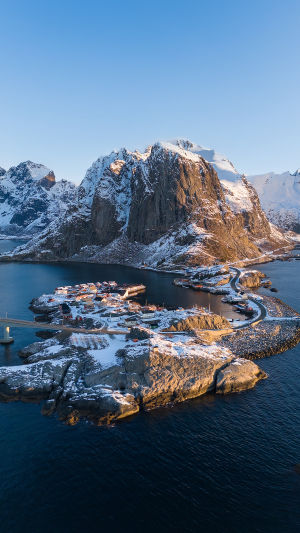
Red wooden cabins cluster on a rock island barely large enough to hold them, connected to the mainland by a single bridge wide enough for one car. The still water around it deepens the sense of isolation, making the village feel suspended between sea and sky.
Behind the village, a granite peak rises almost vertically from the sea, its face streaked with snow and lit in the warm amber of low Arctic sun. The fjord below remains perfectly still, reflecting the mountains like a dark, glassy mirror.
The water in the fjord between the islands is the specific dark blue that only very cold, very deep water produces. Nothing about this scene has been arranged or improved. It simply exists, in the Lofoten archipelago above the Arctic Circle in northern Norway, looking exactly this way in winter and considerably different but equally extraordinary in summer.
Hamnøy is a fishing settlement of fewer than 100 permanent residents on the island of Moskenesøya at the southern end of the Lofoten archipelago. It sits at the point where the E10 road reaches the end of the island chain, surrounded by the dramatic fjord and mountain scenery that has made Lofoten one of the most photographed landscapes in Europe. The village itself is modest in size but enormous in visual impact, and it serves as one of the primary bases for exploring the southern Lofoten islands.
<h3>What Makes Hamnøy and Lofoten Extraordinary</h3>
The Lofoten archipelago stretches approximately 160 kilometers into the Norwegian Sea, its islands forming a wall of jagged peaks that rises directly from the water with almost no coastal plain between the mountain base and the shoreline. This geology, combined with the warming effect of the Gulf Stream that keeps the coast ice-free despite its latitude above 68 degrees north, creates a landscape of extraordinary visual drama in every season.
In winter, the peaks carry snow from October through April, the fjords run deep blue against white hillsides, and the low sun angle produces warm golden light on the rock faces for the brief hours it clears the horizon. The northern lights are visible on clear nights throughout the winter season, appearing over the mountains and reflecting in the dark fjord water below.
In summer, the midnight sun prevents darkness entirely for several weeks, producing a quality of continuous warm light that makes the red cabin villages glow against green hillsides and turquoise water. The landscape is completely different from the winter version, and visitors who have seen only one version often find the other equally compelling.
The traditional fishing cabins visible in Hamnøy and throughout Lofoten are called rorbuer, originally built as seasonal accommodation for fishermen who came to Lofoten for the annual cod season. Many have been converted to tourist accommodation while retaining their characteristic red painted timber construction and waterfront positioning.
Hamnøy
Hamnøy
<h3>Getting There</h3>
The Lofoten Islands are most conveniently reached by flying to Bodo on the Norwegian mainland and then taking either a ferry or a regional flight to the islands.
Bodo Airport receives regular domestic flights from Oslo with Norwegian Air and SAS, with journey times of approximately two hours and tickets starting from approximately $60 to $120 each way depending on booking timing. From Bodo, a high-speed ferry to Svolvær, the main town on Lofoten, takes approximately three and a half hours with tickets costing approximately $25 to $35 per person.
Alternatively, Leknes Airport and Svolvær Airport on the islands receive direct flights from Oslo with Widerøe regional airline, with tickets starting from approximately $80 to $150 each way. Flight time is approximately two hours.
Once on the islands, a rental car provides the most flexibility for reaching Hamnøy and the southern islands. Car rental from Svolvær or Leknes starts from approximately $70 to $100 per day. The E10 road connects all the main islands via bridges and tunnels and is well-maintained throughout the year.
From Svolvær to Hamnøy by car takes approximately one hour and forty minutes along the E10, passing through some of the most scenic road sections in Norway.
<h3>Key Experiences and Costs</h3>
Hamnøy serves as a base for exploring the surrounding area rather than as a destination with specific ticketed attractions. The primary experiences are landscape-based and largely free of charge.
1. The Hamnøy viewpoint, accessible by a short walk from the main road junction above the village, provides the elevated perspective over the island and the surrounding peaks that produces the most recognized view of the settlement. No entry fee. Best visited in the two hours around sunrise in winter for the warm light on the mountain face.
2. The Reinebringen hike above the neighboring village of Reine, a 45-minute steep ascent on a maintained trail with metal steps on the steepest sections, reaches an elevated plateau with panoramic views over the entire southern Lofoten island chain. No entry fee. The trailhead is a 10-minute drive from Hamnøy.
3. The Å village at the road's southern end, the last settlement before the E10 terminates, contains a preserved fishing museum covering traditional Lofoten cod fishing practices. Entry to the Norwegian Fishing Village Museum costs approximately $12 per person.
4. Northern lights viewing from the fjord shore in winter requires only clear skies and patience. Guided northern lights tours by boat or on foot are available from operators in Reine and Å from approximately $50 to $80 per person for a three to four hour session.
<h3>Where to Stay</h3>
Accommodation in Hamnøy and the immediate surrounding area focuses on the traditional rorbu cabin experience.
Hamnøy Rorbu, operated directly within the village, offers converted fishing cabins with fjord and mountain views from approximately $150 to $250 per night. The cabins are self-catering with basic kitchen facilities and the waterfront position provides direct views of the mountain and fjord from the cabin windows.
Eliassen Rorbuer in the neighboring village of Hamnøy offers a larger selection of rorbu cabins from approximately $130 to $220 per night, with some units positioned directly over the water on traditional stilts. The property is one of the most photographed rorbu clusters in Lofoten.
In Reine, approximately five minutes drive from Hamnøy, Reine Rorbuer provides similar cabin accommodation from approximately $140 to $230 per night with access to the village's small selection of restaurants and a convenience store for self-catering provisions.
Lofoten rewards visitors who build enough time into their itinerary to wait for the right conditions. The landscape at its best, with winter sun on the peaks and calm water in the fjord, requires being in the right place at the right hour, which means staying long enough for the weather and the light to cooperate at least once. Three nights is a minimum. Five nights allows for genuinely good conditions on at least two separate occasions. The islands will use every extra day well.


