

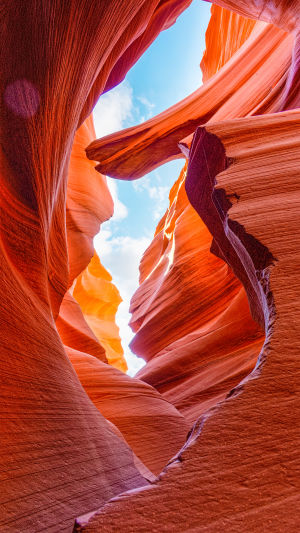
Deep within the heart of the Navajo Nation in Arizona lies a geological masterpiece that looks like it was painted by a celestial hand.
Antelope Canyon is not your typical mountain or valley; it is a narrow crevice carved into the earth by thousands of years of rushing water.
As you step down into its swirling orange depths, the world above vanishes, replaced by flowing sandstone walls that look like frozen waves. This is a place where light and shadow perform a silent dance, creating a visual symphony that has made it a legendary destination for photographers worldwide.
Antelope Canyon
<h3>The Geological Force of Nature</h3>
Antelope Canyon was formed primarily by flash flooding. Over millions of years, rainwater picked up sand and grit, acting like liquid sandpaper as it rushed through the Navajo Sandstone. This erosion rounded the corridor edges, creating the "flowing" shapes that define the canyon today. The walls are not just orange; depending on the time of day and the angle of the sun, they shift through a spectrum of deep purple, vibrant red, and glowing gold.
The canyon is split into two primary sections: Upper Antelope Canyon (known as "The Place Where Water Runs Through Rocks") and Lower Antelope Canyon (known as "The Spiral Rock Arches"). The Upper section is famous for its vertical light beams, which occur when the sun is directly overhead, sending shafts of solid light down to the sandy floor.
The Lower section is narrower and more adventurous, requiring visitors to navigate metal ladders and tight passages, offering a more intimate connection with the stone.
<h3>The Magic of the Light Beams</h3>
The most sought-after experience in the canyon is witnessing the famous beams in the Upper section. These typically appear between late morning and early afternoon during the warmer months. As dust particles dance in the air, the light takes on a physical presence, appearing like pillars holding up the sky. Navajo guides often throw a handful of sand into the air to make the beams even more visible for those capturing the moment.
Even without the beams, the "reflected light" is spectacular. Sunlight bounces off the canyon walls, illuminating the shadows with a soft, warm glow. This phenomenon allows for incredible visuals even in the deepest parts of the corridors. Because the canyon is located on sacred Navajo land, a guide is required at all times.
These guides are experts at spotting "hidden" shapes in the rock, such as the famous "Windy Lady" or "The Lion," which only appear from specific angles.
<h3>Essential Visitor Logistics</h3>
Antelope Canyon is located near Page, Arizona. Because it is on a Navajo Reservation, it operates under tribal jurisdiction and requires specialized permits that are included in your tour price.
<b>Practical Travel Information:</b>
1. Transportation: The closest major travel hubs are Flagstaff (FLG) or Las Vegas (LAS). Most visitors rent a car from these cities to reach Page. Local shuttle services from the Nevada area are available for approximately $120 per person.
2. Opening Hours: Tours generally run from 8:00 AM to 4:00 PM. Access is strictly dependent on weather; if there is any rain in the region, the canyon closes immediately due to water risks.
3. Admission Prices: Prices vary significantly. Upper section tours range from $90 to $120. Lower section tours are slightly cheaper, usually ranging from $55 to $85. All prices include the $8 Navajo Nation Permit fee.
4. Activity Constraints: Bags, tripods, and camera mounts are generally prohibited to keep the flow of people moving. Only a clear water bottle and a handheld camera or phone are typically allowed.
5. Accommodation Options: Staying in Page is the most convenient. Mid-range hotels like the Hyatt Place Page or Courtyard by Marriott range from $180 to $280 per night. Budget-friendly motels are available for $90 to $130.
<h3>Navigating the Lower Section</h3>
For those who prefer a bit of a physical challenge, the Lower section is the place to be. Unlike the flat walk of the Upper Canyon, this area starts with a steep descent down a series of metal stairways. The path is often narrower at the bottom and wider at the top, which creates a sense of being swallowed by the earth.
The textures here are more intricate, with fine lines in the sandstone that resemble the grain of an ancient tree. It is a longer walk, roughly 1.8 kilometers round trip, providing more opportunities to find a quiet corner of stone.
<h3>Safety and Seasonal Planning</h3>
Safety is the highest priority in these narrow environments. Even if the sky above Page is blue, a storm miles away can send a wall of water into the corridors in minutes. This is why the mandatory guides are so important; they are in constant radio contact with weather monitors. To get the best experience, book your tickets at least four to six months in advance. Tours sell out incredibly fast, especially for the prime midday windows when the light is at its peak intensity.
Antelope Canyon is a reminder of the quiet power of water and time. It is a fragile, breathtaking environment that requires respect and wonder. By planning ahead and choosing the right tour for your physical ability, you can experience a world that feels completely detached from the sun-scorched desert above. It is a masterpiece of natural architecture that must be seen to be believed.


