

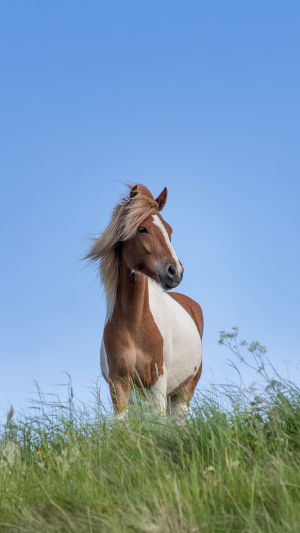
You've likely watched a horse race on television or seen wild horses gallop across open plains, and wondered what makes these animals move with such astonishing speed and purpose.
One moment they're at a steady trot, the next they surge forward, powerful muscles rippling beneath sleek coats, covering ground with breathtaking grace.
However, the beauty of a horse's run isn't just aesthetics—it's rooted in physics, biology, and evolutionary adaptation that allow equines to excel both on the racetrack and in the wild.
<h3>Built for Speed: Anatomy and Muscles</h3>
<b>Long, Efficient Limbs</b>
A horse's body is designed to maximize speed and stride efficiency. Long leg bones and pulley like joints allow limbs to swing forward and backward in a smooth motion, contributing to a longer stride with each gallop. Horses also stand on the tips of their toes, which effectively lengthens their stride and minimizes energy lost to unnecessary limb movement. These limb adaptations are fundamental for both acceleration and sustaining high speeds.
<b>Powerful Musculature</b>
Muscles, especially those in the hindquarters, provide the main source of propulsion. Horses have hundreds of muscles throughout their bodies, and the hindlimb muscles in particular are well developed to deliver the forward propulsion that launches the body into motion. When these muscles contract, they generate the force that drives each powerful stride forward.
<b>Lightweight but Strong Skeleton</b>
Though large, a horse's skeleton is remarkably lightweight and strong. The bones support massive muscle work without weighing the animal down, and tendons and ligaments help transmit muscular force efficiently. This structure allows horses to convert muscular effort into rapid locomotion with minimal wasted energy.
<h3>Gaits and Maximum Velocity</h3>
<b>From Walk to Gallop</b>
Horses move through different gaits—walk, trot, canter, and gallop—each with distinct mechanics and energy requirements. The gallop is the fastest and most powerful gait, typically used in sprinting and racing. During a gallop, there are phases when no limbs touch the ground, allowing for extended strides and greater speed.
<b>Natural Maximum Speeds</b>
An average horse can reach about 50 kilometers per hour (30 miles per hour) at a full gallop. Specific breeds bred for speed, like Thoroughbreds and American Quarter Horses, can exceed these speeds—sometimes reaching more than 64 kilometers per hour (40 miles per hour), and records show elite racehorses even surpassing that figure.
<b>Stride Length and Frequency</b>
Speed isn't just about how fast muscles can move; it's also about how efficiently each stride covers distance. Horses with longer limbs and well coordinated muscle contractions achieve greater stride length and frequency, enhancing their overall velocity. Efficient gait mechanics allow a racehorse to maximize ground coverage with each step.
When a horse reaches cruising speed on a racetrack or races across a meadow in the wild, what you see is the result of anatomy, evolution, and human influence converging into fluid motion. These animals embody a unique combination of strength and grace, and understanding the science behind their speed only deepens our appreciation.
Watching them race isn't just about the destination—it's about seeing nature's design in motion, every stride a testament to millennia of adaptation and refinement.


