

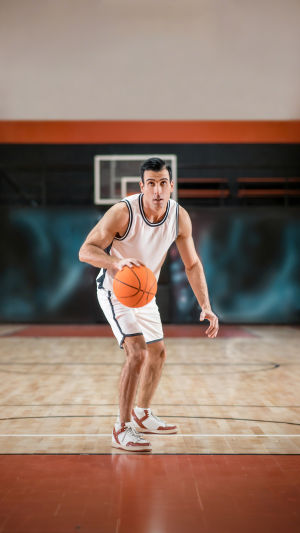
Watching a game, you might notice how effortlessly some players move past defenders, keeping the ball under control while scanning the court.
That smooth movement doesn't come from talent alone—it comes from hours of dedicated dribbling practice.
For basketball players, mastering dribbling is crucial for maintaining possession, creating scoring opportunities, and reading the game effectively.
Improving dribbling requires a combination of technique, coordination, and consistent practice. By focusing on proper stance, hand positioning, and specific drills, players can develop ball control that translates directly into better performance on the court.
<h3>Fundamentals of Dribbling</h3>
<b>Proper Stance and Balance</b>
Maintaining a low, athletic stance is key to effective dribbling. Bend your knees slightly, keep your back straight, and stay on the balls of your feet. This position allows quick changes in direction and helps protect the ball from defenders.
<b>Hand Positioning and Control</b>
Use your fingertips, not the palm, to control the ball. This enhances precision and makes it easier to change dribble height and speed. Practice alternating hands to build ambidexterity and fluidity in movement.
<b>Head Up While Dribbling</b>
One of the most common mistakes is looking down at the ball. Keep your head up to read the court, anticipate defenders, and identify passing or scoring opportunities. This also improves overall awareness and decision-making during the game.
<h3>Basic Dribbling Drills</h3>
<b>Stationary Dribbling</b>
Start in one spot and practice dribbling at different heights and speeds with each hand. Focus on control, consistency, and finger strength. Incorporate crossover, behind-the-back, and between-the-legs moves gradually to build confidence.
<b>Walking and Jogging Drills</b>
Dribble while walking or jogging in a straight line, switching hands periodically. This helps players learn to control the ball while moving and improves coordination between footwork and hand movement.
<b>Cone Drills</b>
Set up cones or markers and dribble around them using both hands. This drill develops agility, quick direction changes, and spatial awareness while reinforcing ball control under dynamic conditions.
<h3>Advanced Dribbling Techniques</h3>
<b>Speed and Change of Pace</b>
Once comfortable with basic dribbling, practice accelerating and decelerating while maintaining control. Changing pace confuses defenders and creates openings for drives or passes.
<b>Combination Moves</b>
Combine crossovers, spins, and behind-the-back dribbles in a fluid sequence. Practicing these combinations enhances creativity, unpredictability, and adaptability on the court.
<b>Defensive Pressure Practice</b>
Work with a partner or use a resistance band to simulate defensive pressure. Learning to dribble under pressure builds confidence, reduces turnovers, and prepares players for game situations.
Mastering dribbling is a gradual process, but with focused practice, players gain control, agility, and confidence on the court. The skills developed through drills translate directly into game performance, allowing smoother movement, better offensive options, and a higher level of overall basketball IQ.
Consistent dedication to dribbling practice ensures that players not only handle the ball effectively but also elevate their overall impact during matches.


