

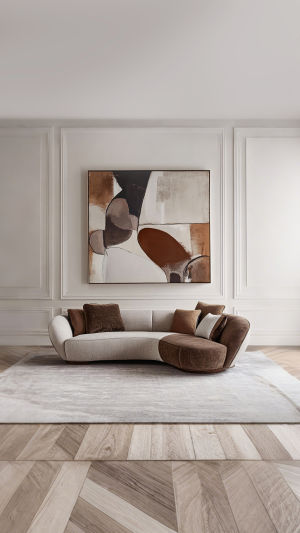
You can rearrange the sofa, swap out pillows, even repaint the walls—but nothing shifts a living room faster than the right rug.
It anchors the furniture, softens footsteps, and quietly sets the tone of the entire space. Choose well, and the room feels pulled together. Choose poorly, and something always looks slightly off.
A great living room rug isn't just about color or price. It's about size, material, placement, and how you actually live in the space.
<h3>Get the Size Right First</h3>
Size is the most common mistake people make. A rug that's too small makes the room feel disconnected.
<b>1. Measure your seating area</b> – Don't guess. Use a tape measure.
<b>2. Keep front legs on the rug</b> – At minimum, sofas and chairs should partially sit on it.
<b>3. Leave even floor borders</b> – Aim for 30–45 cm (12–18 inches) of visible flooring around the rug.
Actionable example: if your sofa is 84 inches long, choose a rug that extends at least 6–12 inches beyond each side. In many standard living rooms, an 8x10-foot rug works better than a 5x7 because it connects all major furniture pieces.
Before buying, outline the rug size on the floor using painter's tape. Live with it for a day. You'll quickly see whether it feels balanced.
When the scale is right, the entire room feels intentional and cohesive.
<h3>Choose the Right Material for Your Lifestyle</h3>
A rug has to handle real life—foot traffic, spills, pets, and daily wear.
<b>1. Wool for durability</b> – Naturally resilient and soft underfoot.
<b>2. Synthetic fibers for easy cleaning</b> – Often stain-resistant and budget-friendly.
<b>3. Natural fibers for texture</b> – Jute or sisal add warmth but can be rougher and may not love spills.
If you have kids or frequent guests, a low-pile synthetic rug is practical. It's easier to vacuum and clean if something spills. On the other hand, if comfort is your priority, wool offers softness and holds its shape well over time.
Here's a simple test: rub your hand across the surface. If fibers shed heavily or feel fragile, it may not handle heavy traffic well.
Matching the material to your lifestyle prevents regret later.
<h3>Think About Color and Pattern</h3>
Color affects mood more than you might expect. A rug can either calm a busy room or energize a neutral one.
<b>1. Use light tones to open up small spaces</b> – Cream, soft gray, or beige reflect light.
<b>2. Choose darker shades for high-traffic areas</b> – They hide stains and wear.
<b>3. Let pattern balance solid furniture</b> – Subtle designs add depth without overwhelming.
For example, if your sofa and chairs are solid neutral tones, a patterned rug can add character. If your furniture already features bold prints, stick to a simpler rug design to avoid visual clutter.
Actionable tip: bring home fabric swatches or sample pieces if possible. Place them on the floor and view them in morning and evening light. Colors shift throughout the day.
The right color choice makes the room feel harmonious instead of chaotic.
<h3>Pay Attention to Pile Height</h3>
Pile height refers to how thick or plush the rug feels. It impacts comfort and maintenance.
<b>1. Low pile for easy cleaning</b> – Ideal for busy households.
<b>2. Medium pile for balance</b> – Comfortable but still practical.
<b>3. High pile for coziness</b> – Best in low-traffic corners.
In a living room where people walk frequently, a low to medium pile is usually smartest. High-pile or deep-pile rugs feel luxurious, but they trap dust more easily and require more maintenance.
Try this: press your hand firmly into the rug. If your fingers sink deeply and fibers take time to spring back, it's high pile. Consider whether you're ready for the extra care it needs.
Choosing the right thickness keeps the rug functional as well as stylish.
<h3>Don't Forget the Rug Pad</h3>
A rug pad may seem optional, but it makes a noticeable difference.
<b>1. Prevent slipping</b> – Adds grip on hardwood or tile floors.
<b>2. Extend rug life</b> – Reduces friction and wear.
<b>3. Improve comfort</b> – Adds subtle cushioning underfoot.
For example, if you place a rug directly on a smooth wood floor, it may shift when someone walks across it. A properly sized pad keeps everything stable and safer.
Make sure the pad is slightly smaller than the rug—about 2–3 cm (1 inch) shorter on all sides—so it stays hidden.
It's a small investment that protects both your flooring and your rug.
<h3>Consider Room Function and Layout</h3>
Every living room functions differently. Some are formal sitting areas. Others are family hubs with daily activity.
<b>1. Define zones in open spaces</b> – A rug can separate seating from dining areas.
<b>2. Align with furniture layout</b> – Center the rug under the main seating arrangement.
<b>3. Leave walkways clear</b> – Avoid placing rug edges in high-traffic paths where they can catch toes.
If you have an open-plan layout, position the rug so it frames the sofa and chairs without extending awkwardly into walkways. This visually anchors the seating zone.
Step back and view the room from the doorway. The rug should guide the eye naturally toward the seating area.
A thoughtfully chosen living room rug does more than cover the floor. It shapes how the space feels and functions every day. When you focus on size, material, color, pile height, padding, and layout, the decision becomes clearer.
Take your time. Measure carefully. Imagine how you'll use the room months from now, not just today. The right rug won't just match your furniture—it will make the entire space feel like home.


