

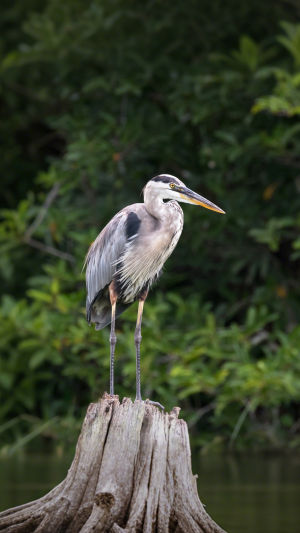
When we see a great blue heron standing still above water, it feels like time slows down. The bird often perches on tree branches, rocks, docks, or tall posts near rivers and lakes. Its long legs support its body, and its neck forms a smooth curve while it stays alert.
Observing this moment helps us understand how the bird rests and watches its surroundings. It does not need to move all the time. Sometimes it simply stands quietly, scanning the water and sky. This calm posture shows its balance, strength, and connection with nature.
<h3>Where We See It Perched</h3>
We often find the great blue heron perched near wetlands. It chooses high spots that give a clear view of water and land. Trees near rivers, mangroves, wooden platforms, and even bridge structures can become resting places.
By choosing higher perches, the heron gains a wide view across water and land, helping it survey for prey and stay attentive to its surroundings.. It also keeps a good sightline for spotting fish or small animals moving below. This position saves energy and improves hunting success.
In coastal areas and lakes, we may see one heron standing alone for long periods. Sometimes it shares space with other water birds, but it usually keeps distance.
<h3>Body Structure That Supports Perching</h3>
The body of this bird helps it perch easily. It has long strong legs with stable joints. These legs allow it to stand on thin branches without losing balance.
Its feet grip surfaces firmly. The toes wrap around wood or rock edges. This grip keeps it steady even when wind blows.
The long neck often folds back while it rests. This shape reduces strain and protects the neck muscles. The bill points forward or slightly downward. From a distance, it looks like a quiet statue above the water.
<h3>Why Perching Matters for Survival</h3>
Perching is not random behavior. It plays an important role in survival. When the bird rests high above the water, it watches for prey movement.
From a perch, it can quickly launch into flight or stretch its neck to catch fish. This quick reaction increases hunting efficiency. It also reduces energy use compared to constant walking in shallow water.
Resting on a safe spot also allows the bird to dry its feathers after swimming or rain exposure. Dry feathers help maintain body temperature and flight ability.
<h3>Behavior We Notice While It Stays Still</h3>
When we observe closely, we see small movements even during rest. The bird may turn its head slowly. It scans left and right. It listens for sounds from water or land.
Sometimes it adjusts its feet or shifts weight for comfort. These tiny actions show alertness. Even while appearing calm, it remains ready to react.
If another bird approaches too closely, it may spread its wings slightly to show dominance or protect space. This behavior helps maintain distance from rivals.
<h3>Perched During Different Seasons</h3>
We notice changes in perching behavior across seasons. During breeding time, adults often perch near nests. They guard eggs and chicks from predators. The perch gives them a wide view of surrounding threats.
In migration periods, we may see individuals resting on high structures before continuing long flights. These rest stops provide energy recovery.
In warmer regions, some birds stay all year. They perch daily while searching for food in nearby waters.
<h3>White Form Seen Perched</h3>
In certain regions like southern Florida, an all-white form of this bird also perches near water. Its white feathers shine under sunlight. The posture and body shape remain similar to the blue-gray form.
Some people wonder about the difference between these forms. Research continues to explore whether the white population represents variation or a distinct group.
Regardless of color, both forms show the same calm standing habit. When perched, they display grace and balance.
<h3>How We Can Respect and Protect It</h3>
When we visit wetlands, we should observe from a safe distance. Avoid approaching too close to perching birds. Sudden movement may cause them to fly away and waste energy.
Using binoculars or cameras with zoom helps us watch without disturbing them. Protecting trees and natural structures near water also preserves good perch sites.
Healthy wetlands support stable food supply and safe resting places. By protecting these habitats, we protect the bird that depends on them.
<h3>Let Us Appreciate the Quiet Moment</h3>
The image of a great blue heron perched above calm water reminds us of patience and strength. It stands quietly but remains alert. It rests but stays ready for action.
We learn from this behavior that stillness can be powerful. Nature teaches balance through simple scenes like this.
Thank you Lykkers for exploring the beauty of a perched heron with us. Let us continue observing wildlife with respect and care.
Get To Know The Great Blue Heron
Video by Forest Preserve District of Will County


