

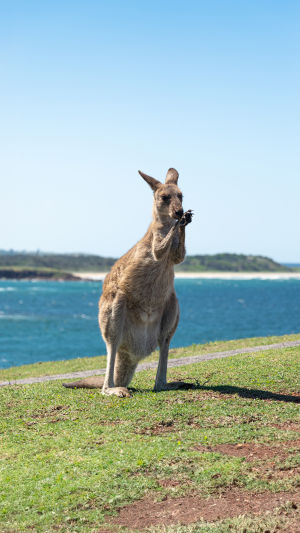
If you've ever watched a kangaroo in motion, it's hard not to be captivated.
Their bounding leaps, upright posture, and pouch life make them instantly memorable. But there's more to these animals than their hopping skills—they hold surprises in behavior, biology, and social life that often go unnoticed.
<h3>Masters of Movement</h3>
Kangaroos are among the most efficient movers in the animal kingdom. Their powerful hind legs allow them to cover long distances with minimal energy.
<b>High-speed hopping</b> – A large kangaroo can reach speeds up to 35 miles per hour over short bursts, using its long tail for balance.
<b>Energy efficiency</b> – Unlike running mammals, kangaroos use elastic tendons in their legs to store energy, making long-distance hopping less tiring than walking or running.
<b>Practical example</b> – Watch a kangaroo traverse open fields: it can cover more than 25 feet in a single bound while conserving energy, a skill that inspired studies in robotics and prosthetic designs.
<h3>Unique Social Structures</h3>
Kangaroos aren't solitary as often thought. They live in groups called mobs, which offer protection and social interaction.
<b>Group dynamics</b> – Mobs can consist of a few individuals to over 100, with dominant males often controlling access to mates.
<b>Communication</b> – Kangaroos use body language, thumping, and vocalizations to warn of danger or establish dominance.
<b>Practical example</b> – When observing a mob, notice how females and young tend to stay in central positions, protected by the alert males on the outskirts. This strategy reduces risk from predators.
<h3>Pouch Life and Reproduction</h3>
One of the most iconic features of kangaroos is their pouch, which serves as a mobile nursery.
<b>Joey development</b> – After a short gestation, the tiny joey crawls into the pouch to continue growing for several months.
<b>Adaptive timing</b> – Female kangaroos can pause embryo development until conditions are favorable, ensuring the survival of the young during droughts or food shortages.
<b>Practical example</b> – Visit a wildlife sanctuary and you may spot a joey peeking out from the pouch, showing how the mother kangaroo balances mobility and care effortlessly.
<h3>Feeding Habits and Diet</h3>
Kangaroos are primarily herbivores, but their diet is surprisingly versatile.
<b>Grazing patterns</b> – They feed mainly on grasses, leaves, and shoots, often grazing during cooler parts of the day to conserve water and energy.
<b>Water efficiency</b> – Kangaroos can survive long periods without drinking, obtaining moisture from the plants they eat.
<b>Practical example</b> – In dry environments, kangaroos shift grazing to areas with early-morning dew, demonstrating adaptability that ensures hydration without relying on water sources.
<h3>Survival Adaptations</h3>
Beyond hopping and social strategies, kangaroos have unique features to thrive in challenging landscapes.
<b>Tail use</b> – Their muscular tail acts like a tripod for balance while standing or fighting and even helps in propulsion during jumps.
<b>Thermoregulation</b> – They lick their forearms to cool the blood as it circulates near the surface, an unusual yet effective method to manage heat.
<b>Practical example</b> – On a hot afternoon, spotting a kangaroo grooming its arms shows this natural cooling technique in action.
Kangaroos are far more than hopping icons—they are intricate animals with clever ways to move, socialize, reproduce, and survive. Observing them closely reveals a fascinating blend of strength, adaptability, and social intelligence.
Next time you see a kangaroo, take a moment to notice its leaps, watch its mob interactions, and appreciate the tiny joey safely tucked in its mother's pouch. It's a reminder that even familiar animals can hold extraordinary surprises.


