

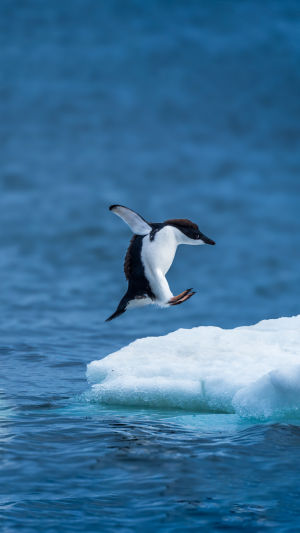
Watching a penguin waddle across ice, it's hard not to admire how unbothered they seem by the freezing wind.
Their tiny bodies look vulnerable, yet they thrive in some of the harshest climates on Earth.
Penguins aren't just lucky—they've evolved a series of remarkable adaptations that keep them warm, dry, and active, even when temperatures drop well below freezing.
<h3>Insulating Feathers and Oil Coating</h3>
Penguins' feathers are more than just a sleek covering—they're an essential survival tool.
<b>1. Dense feather layers</b> – A penguin's body is covered with tightly packed feathers, sometimes up to 100 feathers per square inch. This dense layering traps air, creating an insulating barrier against the cold.
<b>2. Overlapping structure</b> – Feathers overlap like shingles on a roof, preventing cold air and water from reaching the skin.
<b>3. Waterproofing oil</b> – Penguins preen their feathers with oil from a gland near the tail. This oil repels water, keeping them dry when swimming in icy seas.
Example: When diving into freezing water, the outer feathers form a waterproof shell while trapped air provides insulation, allowing a penguin to swim for long periods without losing body heat.
<h3>Insulating Body Layer</h3>
Beneath their feathers, penguins rely on a thick layer of insulation to maintain warmth.
<b>1. Subcutaneous padding</b> – This insulating layer surrounds the body, acting like a thermal blanket that conserves heat.
<b>2. Energy reserve</b> – The layer also stores energy, helping penguins survive periods of fasting, such as when incubating eggs or molting.
<b>3. Uniform distribution</b> – The insulation is evenly spread around the torso, helping maintain core temperature even when extremities get cold.
Practical insight: In zoological settings, penguins are often observed huddling during molting, relying on both feather replacement and their insulating layer to maintain warmth.
<h3>Behavioral Adaptations</h3>
Beyond physical traits, penguins use clever behaviors to stay warm.
<b>1. Huddling</b> – Emperor penguins form large groups, sometimes thousands strong, rotating positions so each bird gets time in the warmer center.
<b>2. Reducing exposure</b> – Penguins tuck in flippers close to their bodies and bend their heads down to reduce heat loss from extremities.
<b>3. Efficient movement</b> – When walking or tobogganing on ice, penguins conserve energy and reduce contact with cold surfaces by sliding on their bellies.
Example: In Antarctica, observing a huddle during a snowstorm shows the synchronized shuffling of penguins as they rotate to ensure everyone stays warm—a remarkable example of group survival.
<h3>Circulatory Adaptations</h3>
Penguins' blood flow is adapted to cold environments, preventing frostbite and conserving core warmth.
<b>1. Countercurrent heat exchange</b> – Arteries and veins in penguin flippers and legs are positioned close together. Warm blood leaving the body warms the cooler blood returning from extremities.
<b>2. Minimizing heat loss</b> – By regulating blood flow to the feet and flippers, penguins maintain body temperature without freezing exposed appendages.
<b>3. Energy efficiency</b> – These adaptations reduce the need for constant shivering or metabolic heat generation, conserving energy for foraging and movement.
Practical note: Even standing on ice for long periods, penguins rarely show signs of frostbite thanks to this precise circulatory design.
<h3>Molting and Seasonal Changes</h3>
Penguins undergo molting, which is critical to staying warm throughout the year.
<b>1. Annual molt</b> – Penguins shed old feathers and grow new ones, ensuring the insulating layer remains effective.
<b>2. Molt fasting</b> – During this period, they rely on stored energy, staying mostly on land while feathers regrow.
<b>3. Seasonal thickening</b> – Some species develop denser feather layers in winter, enhancing thermal protection.
Example: Watching a molting colony, penguins appear stationary for weeks, relying on their body insulation and new feather growth to survive until they can return to the ocean.
<h3>Reflection on Penguin Survival</h3>
Penguins thrive where few creatures could survive, combining physical traits, behaviors, and clever adaptations to endure extreme cold. Their feathers, insulating layer, huddling strategies, and specialized circulatory system work together seamlessly, allowing them to remain active and resilient.
Observing these birds in their natural habitat is a reminder that survival often relies on a combination of nature's engineering and cooperative behavior. Next time you see a penguin, think of the intricate systems keeping it warm—it's a lesson in adaptation, resilience, and the power of teamwork in the natural world.


