

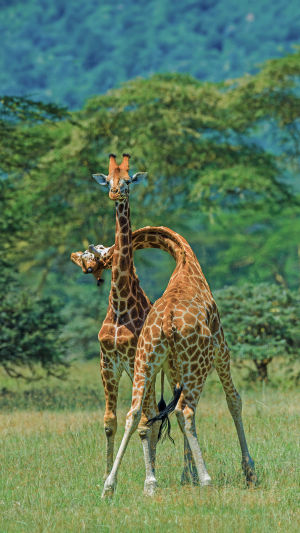
We often see giraffes in pictures or documentaries, but seeing a Rothschild giraffe in real life is a completely different experience. These gentle giants stand tall and move gracefully, capturing our attention immediately.
Today, we are going to explore one of the rarest giraffes in the world—the Rothschild giraffe (Giraffa camelopardalis rothschildi).
While giraffes may seem familiar, this unique subspecies is incredibly rare, and its story shows just how delicate nature can be.
<h3>What Is the Rothschild Giraffe?</h3>
We know the Rothschild giraffe as a special type of Nubian giraffe. It belongs to the animal kingdom, the mammal group, and the giraffe family. Although it looks similar to other giraffes at first glance, it has its own clear identity. Experts consider it one of the most threatened giraffe groups in the world. In 2018, only about 1,399 mature individuals were estimated to be living in the wild. This number is very small for such a large animal.
<h3>Where Do We Find Them?</h3>
We mainly find Rothschild giraffes in East Africa, especially in Uganda and Kenya. One famous place is Murchison Falls National Park in Uganda, where we can still see them walking slowly across open land. Compared with other giraffes that live across wide areas, the Rothschild giraffe has a very limited range. This makes it more sensitive to environmental changes and human activities.
<h3>How Do They Look Different?</h3>
We can recognize Rothschild giraffes by several clear features. Their coat color is lighter than most giraffes, and their body spots look softer and less dark. One of the most special signs is that their lower legs have no spots at all—they are plain and light in color.
We also notice that many of them have five small horn-like bumps on their heads, while most giraffes only have three. These details make them easy to identify once we know what to look for.
<h3>Daily Life and Feeding Habits</h3>
We often see Rothschild giraffes living in small, loose groups. They spend most of their day feeding on leaves from tall trees, especially acacia trees. With their long necks and strong tongues, they can reach food that other animals cannot. This helps them avoid competition and survive in open landscapes. They move slowly, eat quietly, and rarely show aggressive behavior, which makes them look calm and gentle.
<h3>Why Are They So Rare?</h3>
We must understand that their small population is mainly caused by habitat loss. As more land is used for farming, building, and human settlement, their natural space becomes smaller and more broken. In the past, human actions also reduced their numbers. Since they already live in limited areas, even small changes in land use can greatly affect their survival.
<h3>Conservation Efforts and Protection</h3>
We are glad to know that many protection programs now focus on Uganda and Kenya. Wildlife parks, reserves, and organizations work together to protect Rothschild giraffes and provide safe living spaces. The Giraffe Centre in Kenya, for example, plays an important role in education and awareness. Some giraffes are moved to protected areas where they face fewer risks and have better chances to reproduce.
<h3>Why the Rothschild Giraffe Matters</h3>
We might wonder why we should care so much about one type of giraffe. The answer is simple: they are part of a larger natural system. Giraffes help shape the environment by feeding on tall trees and spreading seeds. When they disappear, the balance of the ecosystem changes. Protecting them also means protecting many other plants and animals that share the same space.
<h3>What We Can Do as Lykkers</h3>
We do not need to be scientists to help. We can start by learning about endangered animals and sharing their stories. We can support nature protection programs and choose responsible travel that respects wildlife. Even simple actions, like spreading awareness online, can make more people care. When more people understand the value of these animals, their future becomes brighter.
<h3>Looking Up to the Future</h3>
Lykkers, when we look at the Rothschild giraffe, we are not just looking at a tall animal—we are looking at a symbol of hope and responsibility. Its long neck reminds us to look further, beyond today, and think about the future of our planet.
If we work together, we can make sure these rare tall wonders continue walking across African landscapes for many years to come. We protect them, and in return, they teach us how precious and irreplaceable nature truly is.
The Rothschild's giraffe (Giraffa camelopardalis rothschildi)
Video by EcoQuest Safaris


