

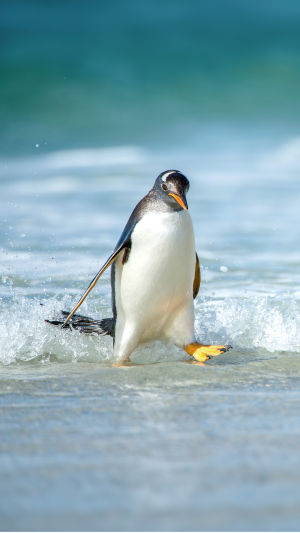
Watching penguins waddle across ice or dive into icy waters, it's natural to wonder: don't they feel the cold? Surprisingly, penguins are perfectly adapted to survive in some of the harshest environments on Earth.
Their bodies, behavior, and social habits all work together to keep them warm despite freezing conditions.
<h3>Insulating Feathers</h3>
Penguins have a dense layer of feathers that acts like a natural winter coat.
<b>Double Layer Protection</b> – The outer feathers are waterproof, keeping ice and snow from reaching the skin, while the inner down feathers trap warm air close to the body. For example, when a penguin dives into frigid water, these layers prevent heat from escaping, allowing it to swim comfortably in near-freezing temperatures.
<b>Feather Maintenance</b> – Penguins regularly preen their feathers, spreading oil from a gland near the tail to enhance waterproofing. Observing a colony, you'll notice birds spending time carefully grooming to maintain this essential insulation.
<h3>Insulating Layers and Body Shape</h3>
Underneath their skin, penguins have a thick layer of subcutaneous tissue that provides extra warmth.
<b>Blubber for Heat</b> – This layer acts as insulation, keeping internal organs warm during prolonged exposure to cold air and water. Even small penguin species have enough blubber to survive harsh winter storms.
<b>Compact Build</b> – Penguins have a round, streamlined shape with short extremities, minimizing heat loss. Unlike animals with long limbs or tails, penguins' body design helps
<h3>Behavioral Adaptations</h3>
Penguins don't just rely on their bodies—they actively manage exposure to cold.
<b>Huddling Together</b> – In extreme cold, penguins form large huddles, pressing bodies together to share warmth. Each bird rotates positions, ensuring everyone gets a turn in the warmer center. Watching an emperor penguin colony, you can see hundreds of birds moving as a single, shifting mass to survive Antarctic nights.
<b>Minimizing Heat Loss</b> – Penguins tuck in flippers and keep heads close to their bodies when resting. They may also hunch forward to reduce the surface area exposed to icy winds, conserving energy for survival and hunting.
<h3>Swimming in Icy Waters</h3>
Penguins are excellent swimmers, and their adaptations extend to underwater life.
<b>Streamlined Movement</b> – Their sleek bodies reduce water friction, allowing fast swimming while using minimal energy. This helps maintain body heat despite cold water temperatures.
<b>Counter-Current Circulation</b> – Blood vessels in penguin flippers and legs are arranged to transfer heat from outgoing blood to incoming blood, keeping extremities warm without losing core heat. Observing penguins diving repeatedly shows that even after long swims, they maintain energy and warmth efficiently.
<h3>Seasonal and Species Differences</h3>
Not all penguins face the same cold, and adaptations vary by species.
<b>Antarctic Species</b> – Emperor and Adélie penguins have the thickest blubber and densest feathers, allowing survival in temperatures as low as −60°C.
<b>Temperate Species</b> – Penguins living in milder climates, like the Galapagos penguin, rely more on behavioral strategies such as seeking shade or swimming to cool off, showing flexibility in adapting to temperature extremes.
Penguins are not afraid of the cold—they are built to thrive in it. Their feathers, insulating layers, behavior, and social strategies combine to create a living system perfectly suited to harsh environments. Next time you see a penguin braving ice and snow, remember it's not just enduring the cold—it's fully equipped to conquer it.


